Welcome to this edition of our Weekly Analyst Insights roundup, which features key insights that our analysts have developed based on the past week’s events.
Late on Friday afternoon, my colleague Anshel Sag posted a simple message to our group chat — “That’s the 5th journalist today” — along with a gif of an exhausted SpongeBob SquarePants. I can sympathize about those times when some story (or set of stories) that’s right in your wheelhouse captures the attention of the press and you find yourself taking calls back to back. While different outlets wanted Anshel’s expertise on multiple topics last week, the flashpoint was SpaceX’s purchase of terrestrial spectrum, which Elon Musk called the “last critical piece of the spectrum puzzle” that his company needs to offer Starlink phone service across the U.S.
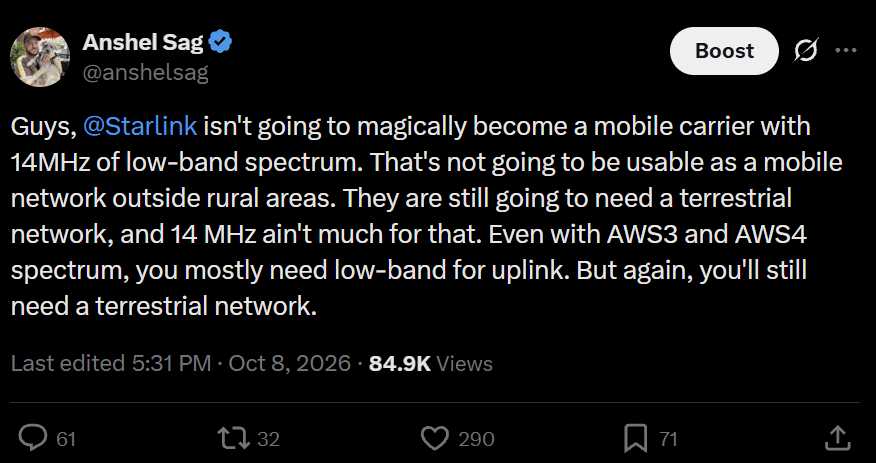
Not so fast, according to Anshel. For journalists from several different outlets, he patiently explained how long the road might be for SpaceX before it’s competing toe-to-toe with AT&T, T-Mobile, and Verizon. He even gave an interview to the European press service Agence France Presse. (It’s a fun bit of cognitive dissonance to see yourself quoted in a language you don’t speak.) You can get his whole explanation in the “Mobile / 5G” section of this week’s roundup. He gave the short version to Monica Alleven of Fierce Network: “I think what [SpaceX is] trying to do is possible. I just think it’s going to cost a lot more than they’re willing to admit, and it’s going to take longer.”
Last week, Anshel was in San Francisco for a Microsoft event, and now he’s across the country in Atlanta for the Augmented Enterprise Summit. Bill Curtis is in New Orleans for the Thread Group members meeting. Bill travels to Silicon Valley next week for a Synaptics analyst event, while Mike Leone will be at the Couchbase Catalyst conference in Florida. As always, we continue to publish fresh content across different formats, so be sure to look for our insights and research — and be sure to follow us on X and LinkedIn.
Last week, Moor Insights & Strategy analysts’ perspectives appeared in business and technology outlets including Reuters, the BBC, Agence France Presse, CIO, Yahoo Finance, CNBC, Seoul Economic Daily, Quartz, The Next Web, TechTarget, TechSpot, DataCenter Knowledge, Benzinga, Technology.org, Hardware Busters, and PhoneArena. Topics included SpaceX’s purchase of terrestrial phone spectrum; public backlash against AI datacenters; HPE’s new ProLiant Gen13 servers; the new Microsoft Surface Laptop Ultra (with NVIDIA chips); the Qualcomm–Huawei patent-license deal; Mark Zuckerberg’s image issues; Oura’s IPO; new capabilities from Precisely; and SAP’s Joule AI assistants and agents.
Our MI&S team also published 13 deliverables — 1 Forbes Article, 1 Research Paper, 2 Analyst Insights, 7 Field Notes, and 2 Podcasts.
Check out this week’s Analyst Insights roundup for more from the MI&S team, including what’s top of mind for each analyst, our thoughts on vendor announcements, press quotes, and more.
Have a great week!
Patrick Moorhead
MI&S Analyst Insights
Behind the Scenes at the IBM Analyst Council
Unlike big public shows, private analyst events ask us to talk rather than listen, and they are scheduled early enough in the process for vendors to act on what they hear. The specifics of last week’s IBM Analyst Council are under NDA, but my takeaway is not: IBM is showing more consistency and conviction than it has in some time. Its early bet on open, transparently sourced, purpose-built Granite models helped set the stage for today’s open-weight wave, and IBM remains confident in its view. At the same time, its acquisition-built automation portfolio is becoming more cohesive, and the teams I met came across as better aligned and more confident than in past conversations. My main pushback was that IBM needs to put the customer and partner journey at the center of its storylines, because buyers want to see how peers got from pilot to production, not just a product roadmap. With the TechXchange event about three weeks out, the test now is whether that internal alignment shows up in the market. Read the full Field Note.
Google’s Gemini Agent Goes Deeper to Win Over Enterprises
Since Google Cloud Next last spring, I’ve watched Google’s agent products line up against established categories, with the Gemini Enterprise Agent Platform positioned against Microsoft Foundry and Google’s Antigravity offering against AWS Kiro and Claude Code. This is a notable shift for a company that usually forges its own path. Last week’s Gemini at Work keynote confirmed that thesis, but I’ve come to see it as a strength. Four things stood out: a unified agent that carries the same memory, context, skills, and governance across five front ends, from web and desktop to command line and mobile; smarter routing that lets the agent choose the best model for each request; a Workspace integration that hangs together more cleanly than competitors’ offerings; and a data toolchain, including Knowledge Catalog and Smart Storage, that extends data science capabilities to knowledge workers and could unlock real process transformation for field-based organizations.
What I want to see next is deeper customer evidence on how organizations configured context and guardrails to reach value, plus back-end routing that helps enterprises optimize model costs. Google now has a more mainstream platform that gives its sellers a clearer story, and enterprises should consider it more aggressively at the front end of agentic experiences. The next step is bringing back more of its creative edge. Read the full Field Note.
SAP Connect Brings Sapphire’s Announcements to Business Users
SAP held its SAP Connect event last week, which targets the key business stakeholders in the SAP ecosystem. I got the chance to speak with journalist Lynn Greiner about it, and she wrote about the event for CIO here. What came across most to me was how SAP was able to deliver on many of the innovations that were announced earlier this year at its Sapphire event, which I attended and wrote about here. Notable is a series of task- or role-driven agents (numbering about 80, up from 40 at Sapphire) that are designed to augment common roles in many enterprises, such as procurement and supply chain. But there is also the backing of the SAP Business AI Platform, which should help enterprises customize these agents to the specific processes and standards for each company. This is a great way for providers like SAP to embed decades of customer understanding within agents while also enabling customers to tune them to suit their needs. While the more specific agents get a lot of attention, I am also interested in hearing more about the payments solution. Although a lot of people are raising concerns about agentic payments, those issues tend to be more around consumer payments. But SAP’s expertise in B2B payments is scoped tightly enough that progress may be easier to come by. Later this month, SAP is hosting its TechEd event, and I am hoping to see it dig into its advances with Joule Studio and Desktop, which should help workers deliver SAP capabilities in the context of common business activity.
Behind the Scenes at the IBM Analyst Council
Unlike big public shows, private analyst events ask us to talk rather than listen, and they are scheduled early enough in the process for vendors to act on what they hear. The specifics of last week’s IBM Analyst Council are under NDA, but my takeaway is not: IBM is showing more consistency and conviction than it has in some time. Its early bet on open, transparently sourced, purpose-built Granite models helped set the stage for today’s open-weight wave, and IBM remains confident in its view. At the same time, its acquisition-built automation portfolio is becoming more cohesive, and the teams I met came across as better aligned and more confident than in past conversations. My main pushback was that IBM needs to put the customer and partner journey at the center of its storylines, because buyers want to see how peers got from pilot to production, not just a product roadmap. With the TechXchange event about three weeks out, the test now is whether that internal alignment shows up in the market. Read the full Field Note.
Google’s Gemini Agent Goes Deeper to Win Over Enterprises
Since Google Cloud Next last spring, I’ve watched Google’s agent products line up against established categories, with the Gemini Enterprise Agent Platform positioned against Microsoft Foundry and Google’s Antigravity offering against AWS Kiro and Claude Code. This is a notable shift for a company that usually forges its own path. Last week’s Gemini at Work keynote confirmed that thesis, but I’ve come to see it as a strength. Four things stood out: a unified agent that carries the same memory, context, skills, and governance across five front ends, from web and desktop to command line and mobile; smarter routing that lets the agent choose the best model for each request; a Workspace integration that hangs together more cleanly than competitors’ offerings; and a data toolchain, including Knowledge Catalog and Smart Storage, that extends data science capabilities to knowledge workers and could unlock real process transformation for field-based organizations.
What I want to see next is deeper customer evidence on how organizations configured context and guardrails to reach value, plus back-end routing that helps enterprises optimize model costs. Google now has a more mainstream platform that gives its sellers a clearer story, and enterprises should consider it more aggressively at the front end of agentic experiences. The next step is bringing back more of its creative edge. Read the full Field Note.
SAP Connect Brings Sapphire’s Announcements to Business Users
SAP held its SAP Connect event last week, which targets the key business stakeholders in the SAP ecosystem. I got the chance to speak with journalist Lynn Greiner about it, and she wrote about the event for CIO here. What came across most to me was how SAP was able to deliver on many of the innovations that were announced earlier this year at its Sapphire event, which I attended and wrote about here. Notable is a series of task- or role-driven agents (numbering about 80, up from 40 at Sapphire) that are designed to augment common roles in many enterprises, such as procurement and supply chain. But there is also the backing of the SAP Business AI Platform, which should help enterprises customize these agents to the specific processes and standards for each company. This is a great way for providers like SAP to embed decades of customer understanding within agents while also enabling customers to tune them to suit their needs. While the more specific agents get a lot of attention, I am also interested in hearing more about the payments solution. Although a lot of people are raising concerns about agentic payments, those issues tend to be more around consumer payments. But SAP’s expertise in B2B payments is scoped tightly enough that progress may be easier to come by. Later this month, SAP is hosting its TechEd event, and I am hoping to see it dig into its advances with Joule Studio and Desktop, which should help workers deliver SAP capabilities in the context of common business activity.
OpenAI Floods Mathematical Archives with Automated Proofs
OpenAI just made 722 math research manuscripts public. The dump spans 372 theoretical result families that were generated by an unreleased frontier reasoning system, all prompted from a single run. Claimed breakthroughs include solutions to the unique games conjecture, the four-dimensional Kakeya conjecture, and partial bounds relevant to the Riemann hypothesis. Academia remains cautious: Just 162 papers included Lean-formalized core proofs, several manuscripts were promptly withdrawn, and independent reproducibility is constrained by a lack of model access.
DOE Backs Automated Research Infrastructure Under Genesis Mission
The U.S. Department of Energy has awarded 12 Phase II contracts under its Genesis Mission. The goal is to accelerate domestic research throughput via autonomous systems. Expanding on 278 preliminary feasibility studies launched in July, this phase funds embodied AI, lab robotics, and closed-loop experimental testbeds across national laboratories. In parallel, Argonne National Laboratory demonstrated an autonomous agent directing synchrotron X-ray microscopy workflows derived solely from natural-language objectives.
The takeaway: While government agencies are stress-testing quantum milestones (see my “Quantum” entry elsewhere on this page), the mathematical community is verifying the outputs of frontier models. In the coming quarters, empirical peer audit should carry more weight than preprint claims.
Few companies can produce a list of the AI jobs running inside their business, and fewer can say what each agent is allowed to do. SAS just shipped software that builds the list, and Google showcased controls for the agents themselves.
In my experience, governance programs stall without that list. SAS AI Navigator is now generally available, and it catalogs LLMs, agents, and open-source models, including ones bought from third parties. Each use case gets mapped to the regulations and internal policies that apply, from experimentation through retirement. I liked AI Navigator when SAS previewed it at Innovate back in April. I like it more now, since teams can use it without changing how they build AI. Two SAS partners offer policy packs with compliance questions and risk ratings already written. And SAS is offering six months of free access, so a company can build its first inventory before paying anything.
Once a company knows its agents, it needs controls on what each one does. Google just held Gemini at Work, its event for companies putting Gemini to use, and introduced the Gemini agent there. I shared my broader take on the Gemini agent on LinkedIn. For governance specifically, I love that every Gemini agent gets its own identity, separate from the person who launched it. Security teams can tell a person’s actions from their agent’s, even inside the virtual machines an agent spins up to run code. Admins write policies once in plain language, like requiring a human to approve any e-mail to an outside partner, and a gateway enforces them on every agent. A spending cap covers the whole job, including tokens, code sandboxes, and compute, and project-level tracking lets a company charge each department its share. That chargeback should make long-running agents easier for finance to approve.
Storage vendors keep moving up the stack into data management. Dell and Nasuni each just announced ways for the systems holding a company’s data to tell agents what that data means and who’s allowed to see it.
Missing business context holds back plenty of agents. An agent can pull a contract and an invoice and never realize they belong to the same customer. Dell announced a semantic layer for its AI Data Platform that gives every app and agent the same business definitions. That layer can import the ontologies and taxonomies a company already keeps. A knowledge graph maps how structured and unstructured data connect, and Knowledge Agents work from a slice of that graph with limits set by the customer. I shared some early thoughts on Dell’s announcement on LinkedIn. I like that Dell builds the semantic layer, knowledge graph, and agents from the customer’s own governed data, inside the customer’s datacenter. Regulated companies whose data can’t leave the building get context without shipping anything out. Dell’s breadth helps too, since it already covers the storage, data engines, and orchestration where that data lives.
Much of that unstructured data sits on file shares. Whenever someone tells me they want agents reading theirs, I ask who last reviewed the folder permissions. Often nobody has in years. Nasuni’s AI Activate connects agents to file data over MCP, the open standard that agents use to reach outside tools. I really like that it checks file permissions before the AI sees anything, so an agent working for someone in sales can’t wander into HR’s folders. I’d put DryvIQ to work early. Nasuni just folded it in, and it finds personal, health, and payment-card data across hundreds of file formats. I’d much rather a company find that data before an agent does.
AMD’s Helion is a reminder that agents need CPUs, not just GPUs. AMD rolled out Helion, an open rack blueprint for agentic AI built on an Open Compute Project (OCP) spec, at the OCP Summit last week. It’s a sibling to Helios. AMD showed two flavors. One is a CPU-only rack with 6th Gen EPYC, up to 32,768 cores, aimed at hyperscalers running agents at scale. The other is an all-in-one rack mixing EPYC, Instinct MI350P GPUs, and general-purpose compute, aimed squarely at the enterprise. There are liquid- and air-cooled options and a built-in token router for sending model calls to the right model. AMD is contributing the spec to OCP, and Cisco, Dell, HPE, Lenovo, Supermicro and others plan to have systems in November.
Why a CPU rack for AI? Think about what an agent actually does all day. It plans, runs code, hits APIs, queries databases, and kicks off workflows. A lot of that is plain old CPU work. The model call gets the attention, but the agent’s busywork around it adds up fast.
For enterprise IT, the all-in-one rack is the one I’d pay attention to. Most of you aren’t going to build a separate agent tier and inference tier. You want one thing you can stand up, manage, and power in the datacenter you already have. And that air-cooled option? It’s a big deal. Many, if not most, enterprise datacenters aren’t ready for liquid.
This should also change how you plan capacity. Everybody’s been counting GPUs. Start counting cores, memory, and networking too. Otherwise, you’ll have very expensive accelerators sitting around waiting on everything else.
Fun connection to the Maia story in the “Datacenter — Silicon” section below: AMD is pitching Helion around making the most of the power you’ve got. Same constraint, different answer.
I like the open approach here. OEMs get room to customize, and you get a choice in who builds and supports the rack. That partner list didn’t sign up for a science project. The two things I want to know are how that token router plays out in the real world, and who owns it. Is that infra’s call? The app team’s? And what CPU-to-GPU ratio will enterprises actually land on?
Lots of good questions, but man, this is a cool move by AMD. It’s the first serious enterprise play I’ve seen.
Microsoft is turning Maia into the engine behind its own AI services. Starting in 2027, Microsoft plans to scale its Maia 300 systems to multi-gigawatt deployments, making Maia the primary inference platform behind Microsoft’s products and services. Coming from a company with Microsoft’s enterprise footprint, that’s not a small thing.
And Maia 300 is a beast. It has eight stacks of HBM4, 288GB of capacity, and 18 TB/s of bandwidth, all inside 950 watts. The compute chiplets are on TSMC’s N2P. Microsoft says a full 96-accelerator rack delivers up to 7x the token throughput of Maia 200, with more than 2.5x the performance per watt. You can stitch up to 12,288 of these together into a superpod over a single Ethernet fabric.
The detail most likely to get buried, but one I really like: memory bandwidth per watt roughly doubled, while compute went up 36%. Microsoft clearly knows where inference hurts. It’s the decode phase, where the model spits out one token at a time and spends most of its life waiting on memory. Microsoft balanced the chip to address that.
So what does this mean for you, the enterprise IT org? Honestly, you’re never going to rent a Maia instance. At least not today. You’ll feel Maia through Copilot, GitHub Copilot, and Foundry. Will your AI services stay snappy and available as usage explodes? That’s where this shows up.
I keep hearing people call this a chip war. Maia versus Trainium versus TPU. I don’t buy it. How many CIOs do you know who are going to pick a cloud based on the accelerator? Zero. They’re buying services. Custom silicon is just one of the levers a cloud provider pulls to make those services better. And GPUs keep growing on Azure right alongside it.
My favorite part of this whole thing is that Microsoft leads its story with tokens per megawatt. That’s the right metric. Power is the bottleneck now, and new datacenter capacity takes years to bring online. Think of it as miles per gallon for AI. If you run AI on-prem, steal this metric. Peak flops won’t tell you what your AI actually costs to run. Tokens per watt and tokens per dollar will.
The thing I’m watching is whether Maia ever shows up as something Azure customers can actually select. I’d love to see that.
Applied Materials opened its EPIC Center last week, and if you care about AI, you should care about this.
It’s a giant collaborative R&D facility in Silicon Valley, roughly a $5 billion investment. Applied calls it the largest-ever U.S. investment in semiconductor equipment R&D. And the guest list is something else. TSMC, Samsung, Intel, Micron, and SK hynix are all founding partners. Broadcom, Advantest, SCREEN, and Besi are in too, along with Stanford, Berkeley, and others.
Why should an IT person care about a materials lab? Here’s a fun fact. The FinFET was dreamed up at Berkeley in 1999, and Intel didn’t ship it in volume until 2012. IBM chased copper wiring for over a decade before it shipped. The idea was never the hard part. Making it work at scale, with good yields, is what ate the years.
That’s the problem with AI right now. The chip vendors are on a yearly release cycle. The materials science underneath them is not. And the industry is juggling gate-all-around, backside power, 3-D memory, hybrid bonding, and chiplets all at the same time. That’s a lot.
EPIC’s pitch is simple: Kill the handoffs. Partners work one-on-one with Applied, on real production-class tools, three or four generations out. Stuff that used to happen in sequence across a bunch of companies now happens in parallel in one building.
So what’s in it for enterprise IT? You won’t buy anything from EPIC, but you’ll feel it. Every accelerator on your roadmap traces back to this layer. Ever waited months on a GPU allocation? Ever seen a system held up by HBM supply? Yeah. This is where that starts.
Here’s what I think people miss. It’s not just about who gets a new chip out first. It’s about how fast that chip gets to good yields. With AI packaging, one bad bond can trash a whole assembly of perfectly good silicon. Getting the chipmaker’s engineers in early fixes that at the source.
Giving agents access to trusted business data usually means connecting them to systems a company already runs. Precisely and Google have both announced ways to do that without rebuilding the data or its definitions for AI.
Prebuilt agents and unified data management are common across data platforms now, so I look for what a vendor has that others can’t easily copy. For Precisely, that’s its own address, property, and location data. A developer can build an agent that pulls in a property’s flood risk, which a company usually wouldn’t have on its own. AI Studio gives developers prebuilt agents and apps that work with the AI assistants they already use. The new Precisely Platform puts integration, quality, governance, master data, and customer communications on one foundation, so a company running several Precisely products needs to set a rule just once. I shared my take on Precisely’s launch with TechTarget. Next, I’d love to see Precisely’s quality and governance scores cover the contracts and manuals that agents read.
Business definitions are the other half of trusted data. As part of its Gemini agent announcement during the Gemini at Work event, Google talked about how Knowledge Catalog maps a company’s business definitions. So, when a Gemini agent reads “net margin,” for example, it knows exactly what that company means by it. I really like that Gemini reads those metrics wherever they’re already defined, whether in Databricks, dbt, LookML, or SAP. Few companies want to move those definitions just to try a new agent. Then there’s operational reporting. A user asks a question in plain language, and Gemini writes the BigQuery query and saves it. Every rerun skips the model, so it costs no tokens and returns the same result each time. I hear plenty of complaints that natural-language reporting costs too much and gives shifting results, but a saved query handles both of those issues.
SpaceX announced the acquisition of 14 MHz of 800 MHz spectrum from the holding company Grain Management. This spectrum was part of the required divestiture tied to T-Mobile’s acquisition of Sprint; it was originally intended for Dish to acquire, but ended up in the hands of Grain Management. SpaceX has been on a campaign to acquire as much spectrum as it can to enhance its network performance as it adds more customers. However, previous spectrum acquisitions by SpaceX have been in higher frequency bands that could be used for satellite communications.
With the acquisition of this new piece of spectrum, SpaceX demonstrates its intent to build a terrestrial nationwide network to complement its Starlink satellite network. This would bring Starlink into direct competition with the big three traditional carriers. SpaceX needs these spectrum bands because existing smartphones are not built to operate on the same bands as the Starlink broadband gateways and have physically incompatible antennas. The problem is that 14 MHz of spectrum won’t be enough bandwidth to supplement satellite connectivity and build a Starlink cellular service. For comparison, T-Mobile had built its 5G network coverage on 31 MHz of 600 MHz, and it struggled with low 4G-like speeds until it deployed its 2.5 GHz network.
SpaceX’s other terrestrial spectrum lies in the AWS3 and AWS4 bands at 2 GHz. The problem with this spectrum is that it doesn’t propagate like the lower bands and is considered more of a mid-band spectrum. This requires cell sites to be much closer together to create usable coverage and bandwidth. This would likely negate the benefits of Starlink’s satellite coverage in filling gaps in terrestrial service by requiring SpaceX to build or lease cell sites in the same areas as the traditional cellular carriers.
SpaceX has yet to deliver a viable plan to build terrestrial infrastructure that would enable it to deploy a cellular network to pair with the Starlink satellite service. While I do believe that Starlink and direct-to-device (D2D) satellite services are going to play an extremely important role in the industry, I think that it will likely be as a component of 5G or 6G and not as the primary anchor for service. I suspect that we will see Starlink deploy a D2D service with a terrestrial cellular component, but I believe it will take at least four or five years to build out and will end up costing tens of billions of dollars to build and operate. This would likely make the network operate at similar margins as other cellular networks — and negate many of the claimed benefits of using Starlink as a backbone for the service.
DARPA Narrows the Field for Utility-Scale Quantum Computing
DARPA advanced four quantum companies to Stage C of its Quantum Benchmarking Initiative: Atom Computing, Diraq, IBM, and IonQ. This is the decisive phase of the QBI. Taking their places alongside Microsoft and PsiQuantum, which qualified via an earlier pilot, this cohort spans four distinct architectures: neutral atoms, silicon spin qubits, superconducting circuits, and trapped ions. Backed by agreements worth up to $300 million, Stage C transitions the program from theoretical validation to empirical government evaluation. Agency officials now view a fault-tolerant, utility-scale machine by 2033 as increasingly probable. High-profile omissions from this cohort include Quantinuum and QuEra.
IonQ Quadruples Quantum Network Interconnect Speeds
IonQ has demonstrated an entanglement rate of 1,032 pairs per second with 87.9% fidelity between a trapped-ion qubit and a diamond quantum memory node. These results outpace the previous trapped-ion benchmark by roughly 4x. High-throughput optical links are critical for modular architectures, which rely on low-latency interconnects to distribute quantum processing without degrading overall coherence. IonQ noted that the optical interface architecture is engineered to generalize across disparate qubit modalities.
Research Paper
- Tackling the API Governance Problem that Resists Being Solved — Pulse Brief (Mike Leone, Patrick Moorhead)
Analyst Insights
- Assessing HPE ProLiant Gen13 for Secure AI Infrastructure (Matt Kimball)
- MI&S Weekly Analyst Insights — Week Ending October 2, 2026 (MI&S Analyst Team)
Field Notes
- Applied Materials Launches EPIC — What Does This Mean for AI Infrastructure? (Matt Kimball)
- Cisco at OCP 2026: Silicon One, NVIDIA Optics and the Network Behind AI (Matt Kimball)
- AMD Helion: Building the Rack Around the Agent (Matt Kimball)
- Microsoft Azure Maia 300: From Custom Chip to Hyperscale Platform (Matt Kimball)
- Google Gemini Agent Goes Deeper to Win Over Enterprise (Jason Andersen)
- Microsoft Brings the AI Router, the Agent Sandbox and the Surface Laptop Ultra to Windows (Patrick Moorhead)
- Microsoft Redefines Windows AI with Surface Laptop Ultra on RTX Spark (Anshel Sag)
Don’t miss future MI&S podcast episodes! Subscribe to our YouTube Channel here.
Press Citations
Data Centers / Matt Kimball / TechTarget
Data center builders confront public AI backlash
HPE / ProLiant Gen13 Servers / Matt Kimball / DataCenter Knowledge
HPE’s Gen13 Signals Enterprise AI Shift to CPU-GPU Balance
HPE / ProLiant Gen13 Servers / Matt Kimball / TechTarget
HPE ProLiant Gen13 lays enterprise AI infrastructure groundwork
Meta / Mark Zuckerberg / Patrick Moorhead / BBC
Mark Zuckerberg has an image problem – so why is Meta’s business booming?
Microsoft / Surface Laptop Ultra & AI PCs / Anshel Sag / Reuters
Microsoft brings more AI to PCs as it challenges Apple
Microsoft, NVIDIA / Surface Laptop Ultra / Anshel Sag, Patrick Moorhead / Benzinga
Nvidia Inside: Microsoft’s New Laptop Runs AI Agents Without the Cloud
Microsoft / Surface Laptop Ultra / Anshel Sag / Seoul Economic Daily
Microsoft Unveils $5,899 Laptop Running AI On-Device With Nvidia Chip
Microsoft, NVIDIA / Surface Laptop Ultra / Anshel Sag / Technology.org
Microsoft Runs a 137B-Parameter Coding Model Locally on Surface Laptop Ultra
NVIDIA, Microsoft / Surface Laptop Ultra / Anshel Sag / The Next Web (TNW)
Microsoft and Nvidia CEOs to launch Surface Laptop Ultra on Wednesday
NVIDIA, Microsoft / Surface Laptop Ultra / Anshel Sag / Quartz
Microsoft and Nvidia are unveiling a new AI-focused Windows laptop
NVIDIA, Microsoft / Surface Laptop Ultra / Anshel Sag / Yahoo Finance
Nvidia Takes Aim at Intel’s $32 Billion PC Business With Microsoft’s Surface Laptop Ultra
Oura / AI Wearables & Oura IPO Pull / Anshel Sag / CNBC
A ‘weird’ IPO pull, a tainted reputation and the stalled breakout moment for AI wearables
Precisely / AI Development Capabilities / Mike Leone / TechTarget
New Precisely capabilities address common AI development hurdles
Qualcomm / Huawei Patent Deal / Anshel Sag / Hardware Busters
Qualcomm-Huawei Patent Deal Flips 25 Years of Royalties, at Least According to the Headlines
Qualcomm / Huawei Patent License Deal / Anshel Sag / TechSpot
Qualcomm signs its first 5G patent deal with Huawei, and agrees to buy some of its US patents
Qualcomm / Huawei Licensing & Diversification Beyond Smartphones / Patrick Moorhead / Benzinga
Qualcomm Licenses Huawei Chip Tech as Its Push Beyond Smartphones Picks Up Speed
SAP / Joule Assistants & Agents / Jason Andersen / CIO
SAP advances its autonomous AI agenda with yet more Joule Assistants and agents
New Gear or Software We Are Using and Testing (New)
- Microsoft Surface Laptop Ultra (Anshel Sag)
- Apple Watch Series 12 (Anshel Sag)
- Unannounced AR Glasses (Anshel Sag)
- Even Realities G2 & R1 Ring (Anshel Sag)
- Unannounced Smart Glasses (Anshel Sag)
- Google Pixel 11 Pro Fold (Anshel Sag)
- Google Pixel Watch 5 (Anshel Sag)
- Galaxy Watch Ultra2 (Anshel Sag)
- Galaxy Watch 9 (Anshel Sag)
- Samsung Galaxy Z Fold8 (Anshel Sag)
- Galaxy Z Fold8 Ultra (Anshel Sag)
- Samsara Tracking Label (Bill Curtis)
- Panasonic Toughbook 56 (Anshel Sag)
- X by Xreal Headset (Anshel Sag)
- Amazon Quick (Jason Andersen)
- MSI Claw 8 EX AI+ Gaming Handheld (Anshel Sag)
- XREAL R1 AR Gaming Headset (Anshel Sag)
- Fitbit Air (Anshel Sag)
- Anker Nano Power Strip (10-in-1, 70W, Clamp) (Anshel Sag)
- Anker Mag Go Prime Wireless Charging Station (Anshel Sag)
- Anker Nano Charger (Anshel Sag)
- Lenovo Legion Go 2 (Anshel Sag)
- OnePlus 15 (Anshel Sag)
- Oppo Find X9 Pro (Anshel Sag)
- Apple M5 MacBook Pro (Anshel Sag)
- Naya Create Modular Keyboard (Anshel Sag)
- 2.0 Antec Flux Pro Case (Anshel Sag)
Events MI&S Plans on Attending, in Person or Virtually (New)
Unless otherwise noted, our analysts will be attending the following events in person.
- AES – Augmented Enterprise Summit, October 12-14, Atlanta (Anshel Sag)
- Augmented Enterprise Summit, October 13-15, Atlanta (Anshel Sag)
- Zoomtopia, October 20, Virtual (Jason Andersen)
- Synaptics Analyst event, October 20, San Jose (Bill Curtis)
- Couchbase Catalyst, October 20-22, Ft. Lauderdale (Mike Leone)
- IBM TechXchange, October 25-28, Atlanta (Jason Andersen)
- Lenovo Analyst Summit, October 26-27, Raleigh (Matt Kimball)
- Oracle AI World + SuiteWorld 2026, October 26-29, Las Vegas (Matt Kimball, Mike Leone)
- Qualcomm Dragonwing IoT Day, October 28, San Diego (Bill Curtis)
- Microsoft Windows and Surface Event, October 7, San Francisco (Anshel Sag)
- Thread Group Keynote, October 12, New Orleans (Bill Curtis)
- AES – Augmented Enterprise Summit, October 12-14, Atlanta (Anshel Sag)
- Augmented Enterprise Summit, October 13-15, Atlanta (Anshel Sag)
- Zoomtopia, October 20, Virtual (Jason Andersen)
- Synaptics Analyst event, October 20, San Jose (Bill Curtis)
- Couchbase Catalyst, October 20-22, Ft. Lauderdale (Mike Leone)
- IBM TechXchange, October 25-28, Atlanta (Jason Andersen)
- Lenovo Analyst Summit, October 26-27, Raleigh (Matt Kimball)
- Oracle AI World + SuiteWorld 2026, October 26-29, Las Vegas (Matt Kimball, Mike Leone)
- Qualcomm Dragonwing IoT Day, October 28, San Diego (Bill Curtis)
- Dell Analyst Summit, November 2-4, Austin (Matt Kimball, Mike Leone)
- Red Hat Analyst Day, November 5, Boston (Jason Andersen)
- Adobe MAX, November 9-12, Miami (Melody Brue)
- Mechanical Orchard Analyst Summit, November 10, Boston (Matt Kimball)
- Commvault Shift, November 10-12, Nashville (Mike Leone)
- AWS re:Invent, November 30-December 4, Las Vegas (Patrick Moorhead, Matt Kimball, Jason Andersen, Mike Leone)
- AWS re:Invent, November 30-December 4, Las Vegas (Patrick Moorhead, Matt Kimball, Jason Andersen, Mike Leone)
Subscribe
Want to talk to the team? Get in touch here!