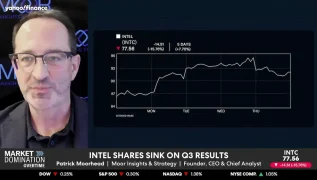
Last Friday I appeared on The Information TV, where anchor Akash Pasricha and I discussed the fallout from Intel’s earnings report and looked ahead to upcoming challenges for Intel and the chip market more broadly. You can check out the video via the link below, or read on for an AI-generated, human-edited overview and summary of the discussion.

Link to The Information TV episode. (Segment starts at 1:57.)
Overview
Intel shares fell significantly following solid quarterly results tempered by lower guidance driven by supply chain constraints, substrate and memory shortages, and softening PC demand. Analyst Patrick Moorhead attributes these issues mostly to broader industry headwinds rather than pure execution failures, contrasting Intel’s manufacturing model with competitors like AMD that outsource production to TSMC. Intel faces negative free cash flow due to heavy capital expenditures into its foundry business, which is not expected to achieve profitability until 2029 or 2030. Despite near-term challenges, Intel’s datacenter business and its margins showed growth, with more developments to come as process node 18A continues to produce and node 14A takes steps toward production.
Outline
Intel Market Reaction and Supply Chain Headwinds
- Akash Pasricha of TITV reports that Intel shares dropped more than 25% following quarterly results and lower revenue guidance tied to supply chain bottlenecks, memory shortages, and declining PC demand.
- Pasricha introduces Patrick Moorhead and asks whether the downturn stems from poor execution or factors beyond Intel’s direct control.
- Moorhead explains that industry-wide headwinds, including substrate shortages and a weak Windows PC market, are heavily impacting results.
- Moorhead notes that Intel’s dispersed manufacturing nodes can make adaptation challenging, plus the company recently dealt with a one-time incident at its Fab 28 in Israel.
Intel’s Free Cash Flow and Foundry Capital Expenditures
- Pasricha asks about Intel’s projected negative free cash flow in 2027 and asks whether such ongoing financial circumstances are acceptable to investors.
- Moorhead states that the deficit is justified by necessary capital expenditures into the foundry business, contrasting this with strong datacenter profit growth.
- He observes that Intel Foundry is currently losing 28 cents per dollar of revenue, likening the massive upfront spending to the capital cycles of major hyperscalers.
- Pasricha contrasts the public and political reception of chip factories with datacenters, noting that foundries encounter far less pushback despite their intensive footprint.
- Moorhead agrees, but points out that decades of community engagement have helped foundries avoid some of the negative public scrutiny frequently directed at datacenter power usage.
Intel’s Foundry Roadmap and Technology Nodes
- Pasricha asks about the expected timeline for Intel’s foundry division to reach sustained profitability.
- Moorhead forecasts foundry profitability around 2029 or 2030, citing the extensive time required to establish cutting-edge transistor technology and to secure external customers.
- Moorhead anticipates that Google and AWS will use Intel for packaging, while Apple and NVIDIA could seek Intel wafer capacity as secondary domestic sourcing options.
- He reviews process milestones, highlighting solid progress on node 18A yields, timely 14A design kits, and a planned 2027 convergence allowing interchangeable manufacturing between PC and server parts.
Chip Sector Outlook and Broader Industry Demand
- Pasricha inquires about broader expectations for upcoming earnings reports from competing semiconductor firms such as AMD.
- Moorhead predicts ongoing momentum for datacenters, with TSMC supporting AMD, alongside a likely downward revision for PC shipments across the board.
- Moorhead argues that consumer PC demand is deferred rather than lost entirely, as aging hardware will eventually compel upgrades regardless of elevated memory prices.
- Pasricha asks how memory constraints and supply chain issues may affect other chipmakers in the market.
- Moorhead notes that NVIDIA has secured critical substrate supplies through deep Japanese partnerships, though industry-wide capacity constraints for advanced wafers and datacenter memory seem likely to persist for years.
Companies Mentioned
- Intel
- AMD
- Microsoft
- TSMC
- SpaceX
- AWS
- Apple
- NVIDIA
Keywords
Intel, foundry, TSMC, AMD, NVIDIA, semiconductors, datacenter, 18A, 14A, substrates, chip packaging, capex