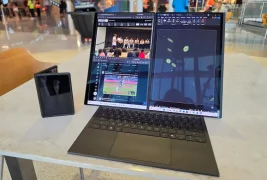
The Motorola Razr Fold is the company’s first foray into a book-style foldable after building multiple generations of flip-fold phones. The company first teased the Razr Fold at CES earlier this year, then launched it at MWC 2026 with availability in the summer. Since then, we have also seen it gain carrier availability with T-Mobile and Verizon, which helps with improving adoption. This put the Razr Fold launch well ahead of its competitors, such as the Google Pixel 11 Pro Fold, the Samsung Galaxy Z Fold8, and even Apple’s iPhone Duo foldable. I believe that, because of the rate of new foldables coming out since the Razr’s launch, the Razr Fold is the most slept-on foldable on the market.
The Razr Fold Is Not Just a Paper Tiger
The Razr Fold comes in only one configuration, at $1,899 with 16GB of RAM and 512GB of storage. This is the same price as the Pixel 11 Pro, which also has 16 GB of RAM but just 256GB of storage. It is also priced at about $200 less than the Fold8 Ultra, yet it has more RAM than both of the comparable Fold8 devices (unless you spring for the 1TB model, which matches it at 16GB). The inner screen is an 8.1-inch 2234 x 2484 120 Hz LTPO display; this is slightly larger than the competition, which all have 8.0-inch displays. The cover screen is also a larger 6.6-inch 2520 x 1080 165 Hz display, which has a higher refresh rate than the competition’s 120Hz. It also offers a higher peak brightness of 6,000 nits, which can be very useful outdoors.
The silicon-carbon battery in the Razr Fold, at 6,000 mAh, offers 20% or more extra capacity than the competition. The larger battery also benefits from much faster wired (80W) and wireless (50W) charging. In fact, wireless charging for the Razr Fold is faster than wired charging for its U.S. competitors. That said, it does not have Qi2 charging because it lacks the necessary magnets on the back of the phone, which the Pixel Pro 11 Fold does have. The Pixel also has the industry’s first IP68 water resistance for a foldable, while the Razr Fold ships with IP48. Another thing to consider is that the Razr Fold comes with pen support via the Moto Pen Ultra, something its competitors (besides the not-yet-available Apple Duo) lack.
The Razr Fold Lacks Cutting-Edge Performance
The one area where the Razr Fold is, without a doubt, at its weakest is performance. In Geekbench 7 tests, the single-core performance (1,168 points) was less than half that of most other comparable Android foldable devices. Multi-core performance was more competitive, though the Razr Fold’s more affordable Snapdragon 8 Gen 5 chip couldn’t keep up with the phones powered by the Snapdragon 8 Elite Gen 5 processor, which includes the Galaxy S26 Ultra, Fold8, and Fold8 Ultra. To be clear, Geekbench multi-core performance was quite bad at 5,800 points, albeit much closer to or surpassing that of some older Google Pixel Pro Fold devices.
GPU performance was an entirely different story, and it was actually competitive with last generation’s processors, which makes sense given that the Snapdragon 8 Elite Gen 5 was released before the Snapdragon 8 Elite Gen 6 or the A20 Pro in comparable Apple phones. In 3DMark Wildfire Extreme tests, the Razr Fold kept up with the iPhone 17 Pro and blew away the Pixel 11 Pro Fold, which is known to have a weaker GPU. That said, in Solar Bay and Steel Nomad 3DMark tests, the Moto was still a good 20% to 30% slower than last generation’s GPUs. Compared to the new Snapdragon 8 Elite Extreme Gen 6, it had half the GPU performance.
That’s what the numbers say. I want to add that in all my real-world use of the Razr Fold, I did not once think it was using an inferior chip, or that apps running on it felt slow. I definitely think that at times these processor wars might be a bit overblown, and that most applications simply don’t need cutting-edge performance. But in many ways, perception is an important factor, and Motorola took a risk with the Razr Fold, especially because it shipped a faster chip in the Razr Ultra, its flip phone.
Making Up for Performance with Great Connectivity and Camera Features
What this phone lacks in performance numbers, it makes up for in connectivity and camera capability. One thing many people don’t know about the Razr Fold is that it is the first smartphone in the U.S. market to ship commercially with a 6Rx antenna configuration. This means it now has six antennas for transmitting and receiving signals, allowing the phone to significantly improve overall throughput and cell-edge performance, as well as overall coverage. This was initially launched on T-Mobile, and Moto claims that it allows up to 20% better throughput, coverage, and battery life.
The Razr Fold also has one of the biggest batteries in a foldable, which enables it to have some of the best battery life of any foldable I’ve tested thus far. Even compared to some industry leaders in the foldable space with similar or larger batteries, tests have found it to be the best or among the best in battery life. Considering that battery life is one of the most important metrics for most smartphone users, I think Motorola made the right choice with this phone’s specs. To fill up that battery, Motorola also implemented the industry-leading 80W charge mentioned earlier, which can charge the phone to 30% in 10 minutes or to full in under 60 minutes.
The camera is also one of the most important factors for consumers, so I was impressed when Motorola released this phone with the camera that scores the highest on DXOMark of any foldable. Even today, months after its release, it remains the highest-ranked foldable camera on the market and in the top 15 among all phones in the industry. The reason this is so important to me is that camera performance has been a hallmark weakness of most foldables since their inception and — since I’m a photography nerd — has prevented me from making a foldable my primary phone. This phone’s camera performance is grounded in a true triple-50MP camera configuration, something that was standard across many flagship non-foldable phones last year. I am continually impressed by the Razr Fold’s camera setup, and it has inspired me to bring this phone with me almost everywhere. One minor drawback: Motorola uses Google Photos as its camera gallery, which I don’t think is necessarily the best gallery app. I like Google Photos for browsing everything that I have in the cloud, but on-device I’d like something more powerful and capable.
Motorola’s Move Upward into Premium Foldable Phones
Motorola used to be synonymous with cheap, well-built phones that delivered great value. With the Razr line of flip phones and now the Razr Fold, the company has demonstrated that it is not only willing but also capable of building a flagship-tier foldable phone. While the Razr Fold might not have flagship performance due to the Snapdragon 8 Gen 5 chip, it does offer class-leading specs in virtually every other way that matters to consumers.
The fact that the Razr Fold has already been picked up by two of the big three U.S. carriers demonstrates to me that it fills a market need not satisfied by Samsung or Apple. Motorola is also working with GrapheneOS to give its foldable customers more operating system choices and greater privacy with the next generation of Razr devices (though I wish that were possible to apply retroactively). Regardless, its combination of premium attributes makes Motorola’s Razr Fold, even at $1,899, possibly the most slept-on foldable in the market today.