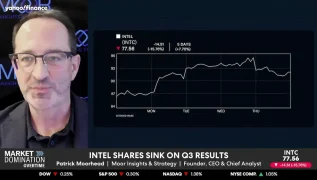
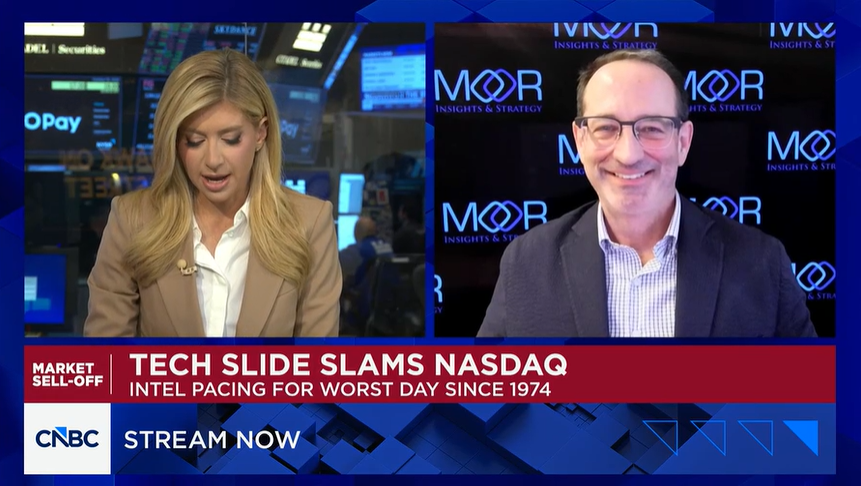
This morning I appeared on CNBC to discuss Intel’s latest earnings (released yesterday) and what I regard as the overreaction of the stock market to its weaker-than-expected revenue guidance for the fourth quarter of 2026. You can click the link below to see a video excerpt of the conversation, or read on for an AI-generated, human-edited overview and summary of the full discussion.
Overview
Intel shares suffered a sharp decline following weak current-quarter guidance linked to a slowing PC market and elevated memory chip pricing. Analyst Patrick Moorhead argued the selloff represents an overreaction, noting that Intel’s core investment appeal centers on its foundry business rather than short-term PC fluctuations. While substrate shortages and supply misalignments pose near-term headwinds, deferred PC demand should eventually recover as memory prices normalize by 2028. Meanwhile, Intel is consolidating manufacturing onto advanced 18A nodes to improve profitability. AMD faces less immediate operational risk due to robust TSMC wafer allocations. Intel’s broader recovery under Lip-Bu Tan remains a multi-year turnaround effort.
Outline
Intel Market Reaction and Valuation Debate
- Sara Eisen of CNBC notes that Intel is pacing for its worst single-day performance since 1974 after issuing disappointing current-quarter guidance tied to a slowing PC market and elevated memory pricing.
- Patrick Moorhead argues that the steep selloff is unjustified because investor interest has centered on foundry capabilities rather than short-term PC sales.
- Moorhead notes that substrate availability and PC softness were widely anticipated across the industry.
- Eisen asks whether Moorhead considers the depressed share price a buying opportunity.
- He states that Intel’s long-term outlook remains positive, calling the drop from 120 dollars down into the 60s an attractive value proposition.
Foundry Alignment and PC Market Dynamics
- Eisen asks whether worsening PC demand jeopardizes Intel’s momentum in building out domestic foundry and AI operations.
- Moorhead explains that Intel’s profitability should improve significantly by 2027 as PC and server chips align on the in-house 18A and 18AP nodes rather than being scattered across external suppliers like TSMC.
- He observes that consumer PC demand is deferred rather than lost, as aging systems must eventually be replaced.
- CNBC’s Carl Quintanilla asks when high memory prices might stabilize enough to unlock that pent-up PC demand.
- Moorhead projects that PC memory prices will normalize around 2028, while server memory constraints could persist through 2030 based on disclosures from Micron and SK.
Competitive Comparison Between Intel and AMD
- Quintanilla highlights the widening six-month performance gap between AMD and Intel, asking whether AMD faces similar risks ahead of its earnings.
- Moorhead explains that AMD carries less downside risk due to flexible wafer and packaging supplies from TSMC.
- He points out that TSMC has strong competitive incentives to keep AMD fully supplied to contest Intel’s foundry expansion.
- Moorhead concludes that he remains optimistic regarding AMD’s near-term execution.
How Intel Is Navigating Business Transformation and Execution
- Eisen quotes a Bernstein analyst note regarding the challenge of surviving current disruptions before reaching future goals, comparing Intel’s shift to Google’s transition toward artificial intelligence.
- Moorhead agrees that Intel must navigate a difficult transition, reiterating that CEO Lip-Bu Tan has characterized the recovery as an extended, multi-year turnaround.
- Moorhead states that he will review incoming results from peers like AMD to determine whether Intel’s operational challenges stem from broader industry supply headwinds or company-specific execution issues.
Companies Mentioned
- Intel
- AMD
- TSMC
- Micron
- SK Hynix
Keyword Summary
Intel, earnings, foundry, PC market, memory chip pricing, substrates, AMD, TSMC, data center, AI, Lip-Bu Tan