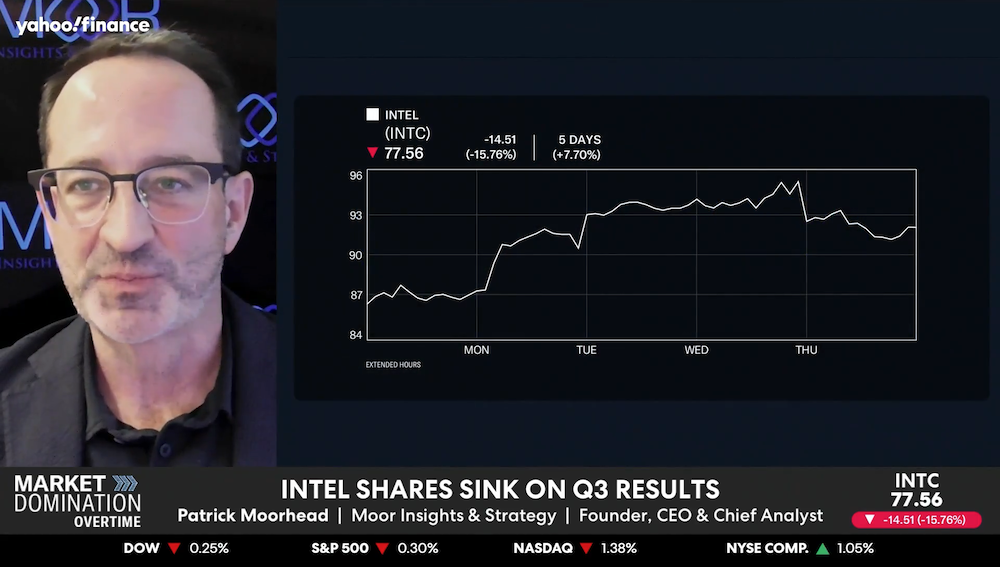
Yesterday I appeared on Yahoo Finance to discuss the specifics and the fallout from Intel’s just-released earnings report. You can watch a short video excerpt via the link below, or read on for an AI-generated, human-edited overview and summary of the full conversation.
Overview
Intel shares dropped significantly in aftermarket trading following third-quarter results that beat expectations but offered a weak fourth-quarter revenue outlook. Analyst Patrick Moorhead attributed the shortfall to broader headwinds, including declining PC demand driven by surging memory prices, potential substrate shortages, and reports of an incident at an Intel fabrication facility in Israel. Despite these immediate pressures, positive growth drivers remain in the datacenter business and rising CPU demand fueled by agentic AI workloads. Future stability will depend on management addressing substrate supply constraints, clarifying the impact of the Israel facility incident, and confirming customer traction across its advanced packaging and foundry nodes.
Outline
Intel’s Third Quarter Results and Initial Market Reaction
- The Yahoo Finance anchor introduces the segment by noting that Intel shares are dropping following its third-quarter results, which beat earnings expectations but missed revenue guidance due to weakening PC sales.
- Patrick Moorhead explains that while the quarter beat on most metrics, fourth-quarter guidance fell approximately $1.5 billion short of expectations.
- Moorhead points out that besides weak PC demand, contributing factors include scarce chip substrates and reports of an incident at an Intel fabrication facility in Israel.
- He highlights positive performance in the company’s datacenter business, noting it grew 15% in the fourth quarter to achieve another record.
Headwinds in the PC Market and Memory Pressures
- The anchor asks how surging memory prices are affecting Intel and how management might address the issue during the earnings call.
- Moorhead observes that the PC market is down 15% to 25%, primarily due to severe memory shortages and corresponding price increases.
- He states that doubling or tripling memory costs directly impacts profitability for both PC vendors and component manufacturers.
- Moorhead also emphasizes that PC demand is deferred rather than destroyed, predicting that sales will rebound once memory supplies improve and prices decline.
AI Demand and Foundry Pipeline
- The anchor inquires whether rising demand for artificial intelligence CPUs presents a significant tailwind for the company.
- Patrick Moorhead notes strong datacenter growth driven by agentic AI, which requires high CPU-to-GPU ratios ranging from one-to-one up to two CPUs per accelerator.
- Moorhead cites Intel CEO Lip-Bu Tan projecting $40 to 200 billion in new CPU demand over the next three to five years.
- The anchor asks about potential foundry partnerships with major firms such as Google, NVIDIA, and SK Hynix.
- Moorhead points to increased 2027 capital expenditures as evidence of major wafer and packaging customers, highlighting progress on the 14A and 18A-P process nodes alongside upcoming client parts and the Granite Rapids server chip line.
Intel Investor Priorities and Management Expectations
- The anchor notes that Intel stock is down roughly 15% in after-hours trading and asks what management must communicate to stop the decline.
- Moorhead states that management cannot alter market-wide PC dynamics but must explain how they plan to secure sufficient substrates for wafers and packaging.
- He emphasizes the urgent need for clarity regarding the reported explosion at the Israel foundry, including estimated downtime and affected chips.
- Moorhead also stresses that Tan needs to provide credible reassurance and transparent updates regarding the progress of Intel’s foundry business.