Key Takeaways
- Executives want AI that works from their business’s own context, meaning its definitions, relationships, and rules. That context is scattered across tools today, and AI-built apps keep making new copies of it.
- Resilience matters most. Models get retired, tools get consolidated, and regulations change, but the context that the business relies on must come through each change intact.
- Qlik has engineered its solutions with the goal of creating the resilient context, trust, and choice that leaders want. It does this by keeping data from ERP applications, mainframes, and other core systems current and letting people and agents explore beyond predefined queries. Business definitions, quality scores, and lineage live in one governed place, and assistants and agents from other vendors can draw on them through open standards.
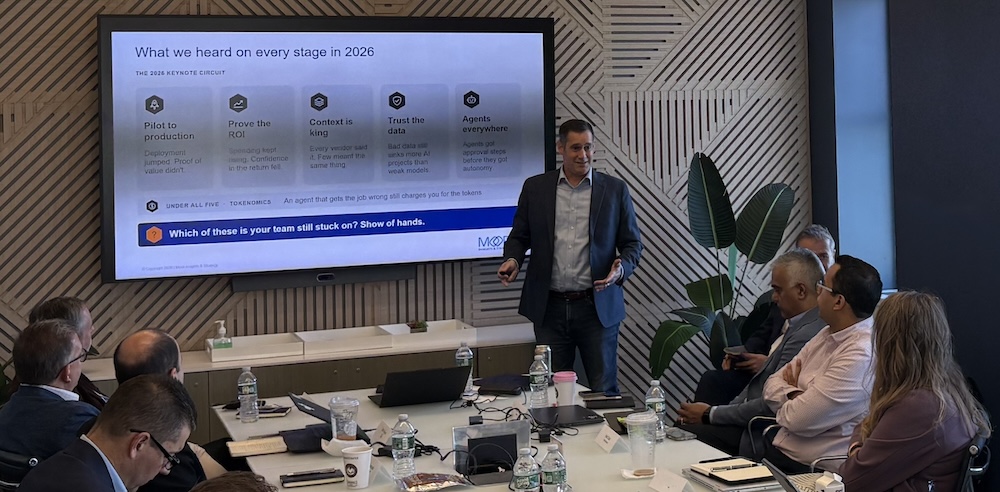
Meeting with advisory boards is my favorite part of the analyst’s job, because customers will tell you outright what’s working and what’s still in the way. Recently I spent time in New York with Qlik’s Executive Advisory Board, a group of senior executives from Qlik customers. The conversation centered on where their data and AI programs go next. Advisory boards run on candor and assurances of privacy, so no specific companies or individuals will be cited here.
What I can share is the shape of the conversation. It kept coming back to context, meaning the knowledge of how a business works that AI needs before it can produce a useful answer. Other recurring themes were the sprawl of data and AI tools these companies run, along with the new apps that AI now lets anyone build. Underneath all of this sat a demand for speed, trust, and resilience. The resilience these leaders care about most belongs to the trusted context itself. That context has to survive the introduction of new AI models, consolidated tools, or new regulations.
Scattered Business Context Breaks Easily
Nearly every vendor keynote I’ve attended this year has said that context is king, but few of the speakers meant the same thing by the word “context.” For the executives running these programs, context is practical. It covers which customers count as active, which contracts apply to which buyers, and what system users are allowed to do about each of them. That knowledge sits inside BI tools, data catalogs, pipeline logic, documents, and the heads of long-tenured employees.
Such scattered context is fragile. When one of those employees retires, part of the context leaves with them. When one team changes a definition in its BI tool, the copies in other tools keep the old definition. Any change like this alters what the AI knows about the business, yet nobody gets an alert.
The fix is to have a single governed map of the business, which I covered earlier this year in a piece about what context means in AI. AI can now draft much of that map, but people who know the business must still review it. Keeping that review in-house means the reasoning behind the map stays with the company when an outside engineer moves on.
The map also needs current data underneath it. A rule about which customers count as active does little good if the order data behind that rule is a week old. When orders and payments run through an ERP system or a mainframe, the data has to flow out of those systems as it changes. Otherwise AI reasons from a partial, outdated picture of the business.
Consolidate the Layer That Holds the Context
Most large companies run more data and AI tools than anyone would pick if they were starting fresh. This happens because different business units have bought their own data platforms, BI tools, catalogs, pipeline software, and now AI assistants. When two agents built on two tools answer the same question with two different numbers, people stop trusting both agents.
The pull toward consolidation makes sense, since fewer tools means fewer contracts, fewer skills to maintain, and fewer places for definitions to drift apart. The risk is consolidating the wrong things. AI models change faster than enterprise buying cycles, so tying the whole stack to one model or one assistant buys simplicity now — but a painful migration later.
The part worth consolidating is the layer where the company stores its business definitions, data quality rules, and rules about who can see what. Teams can still pick their own AI assistants and models, as long as each one pulls from the same shared definitions. Keeping those definitions in one governed place makes the company’s context resilient. When a model gets retired, prices change, or a regulator adds a rule, the company can swap the model or update the rule without redefining its own numbers.
I’d argue that control is the most critical part of agentic AI, and it reaches well beyond controlling the agents themselves. It means control over the entire data estate, which includes knowing where data lives, deciding who and what can use it, and being able to prove all of this if a regulator asks. Sovereignty and compliance have pushed many companies to start building that type of control, but its value goes further than either sovereignty or compliance, because the same control decides which AI models see which data and which agents can act on it.
Trusted Context Helps AI Move Fast
Leaders want speed, trust, and resilience all at the same time, but they usually hear that they must pick just two. Moving fast means skipping quality checks. Conversely, trusting every number means re-checking it, which slows everything down. Building for resilience adds redundancy, which costs both time and money.
In my view, those three goals pull against each other less than most leaders assume. A lot of the delay in enterprise AI comes from people re-checking numbers they don’t trust. When data arrives complete with its definition, its lineage, and a quality score, people can act on it right away. Lineage is the record of where a number came from and what happened to it along the way. Trusted data lets a company move fast without taking on new risk.
Agents raise the stakes on stale context. A person who spots an odd number usually stops to ask about it. But an agent just keeps going, so an outdated definition can spread into hundreds of decisions before anyone notices. Keeping context current with the latest events in the business lets a company hand more work to agents safely.
Dashboards Still Matter to the People Running the Business
More people inside enterprise organizations are vibe-coding their own apps — simply describing what they want and letting AI build it. A sales manager can build a quote calculator, or a plant supervisor a maintenance tracker, in an afternoon. They don’t have to wait for IT to build the app or for the data team to build the pipelines behind it.
Problems start as the number of these apps grows. Each app pulls its own data and decides for itself which table counts as the correct source and how to calculate the numbers it shows. That makes every app a private copy of the company’s context. Many of these apps never come to the attention of the data team, so nobody checks whether their numbers match the official ones. Leadership never approves most of them, either, so nobody knows which apps the business has quietly come to depend on, or for which decisions. A company working hard to cut its tool count can end up with hundreds of these apps instead.
I hear from leaders who feel pulled in two directions. Executives want their people building, and few of them want to shut that energy down. Yet data leaders inherit the cleanup chores, trying to reconcile numbers from apps they never knew existed. Both groups still need one place where everyone sees the same numbers.
For the executives I connected with at Qlik’s Executive Advisory Board, that place is still the dashboard. Plenty of people have declared dashboards dead this year, and it’s true that a chat window really is enough for some quick questions. But a chart on a dashboard can still show a trend faster than a paragraph of text in a chatbot can. And a shared dashboard also means that a leadership team is looking at the same number instead of three versions of it.
A predefined query answers the question someone thought to ask, and only that question. By contrast, a good dashboard gives people room to explore. Clicking through to see the data can show relationships nobody went looking for. The same clicks can show what’s missing, such as customers who stopped buying a product line. I think agents need that same room to operate, or they end up confirming what the business already knows.
AI assistants are now building dashboards too, which opens up dashboard building to almost anyone in the company. I wrote about that shift in a Forbes piece about Claude Dashboards. To be clear, a chat-built dashboard is fine for a quick look. But once it gets shared, or someone makes a spending decision from it, any dashboard should be using the company’s approved definitions and be reflected in its official BI tool.
Where Decision Intelligence and AI Agents Could Go Next
At the meeting in New York, I put a few bigger ideas on the table, and said up front that I’m not sure I’m right about all of them. One idea is to use AI to extend decision intelligence, the practice of modeling a decision before making it. Companies have simulated their customers for years using segments, personas, and statistical models, but those models only estimate how the members of a group might react on average. By contrast, an AI stand-in can answer a brand-new question much as a specific person would. AI stand-ins are driving a resurgence in decision intelligence that reaches well beyond customer simulation. A company could model how employees, suppliers, or competitors might react to a decision before it makes the call. The more business context there is behind each stand-in, the more believable the simulation gets, so having the right context becomes a real competitive advantage.
Another idea is agents negotiating with agents. Some large buyers already let AI agents negotiate with their suppliers, and suppliers are starting to send agents of their own. When two agents face off, the better agent tends to get the better deal, and being better often comes down to the trusted data and context feeding it. Price history, supplier performance, and a clear sense of what the company is willing to give up all shape the outcome. Before a company lets an agent commit it to a deal, leaders have to trust the data, the context, and the agent using both. Keep in mind that companies have trusted software to execute deals before. What’s new is the scale, with agents potentially handling thousands of negotiations a day. That scale is wild to think about.
Simulated decisions and agent negotiations both depend on what happens after a decision is made. Decision intelligence shouldn’t stop at modeling the decision. It should also record what the company decided, what action followed, and whether the result met the goal. That record matters even more once agents are the ones acting. Each recorded outcome can then feed the next decision as context, helping the AI stand-ins and the agents improve over time.
The last idea I presented is that control opens new doors. For example, the control that a company builds, initially probably to support sovereignty and compliance, shows which of its data it could license to others. Licensing can turn that data into a new line of business. The same control makes it possible to build AI with competitors. Rivals are starting to train shared AI models on problems a whole industry faces, such as fraud. Each company keeps control of its own intellectual property and decides which data it can share that would add value across the industry. Nobody wants to hand a competitor an advantage, but a shared model that catches more fraud or speeds up drug discovery lifts the whole market, and drug makers and banks have already run early versions of this type of collaboration.
How Qlik Delivers Trusted Context for Enterprise AI
Qlik continues to deliver what these leaders are asking for, organized around the three pillars it laid out back at Qlik Connect in April — context, trust, and freedom.
- Context: Qlik moves data from core systems, including ERP applications and mainframes, and streams changes from them in real time. Its governed data products carry shared business definitions that its agents, analytics apps, and outside AI assistants all work from, so answers match across tools. The Qlik Analytics Engine shows people and agents how the data connects and which data a query excludes.
- Trust: The Qlik Trust Score rates how ready a dataset is for AI, and lineage travels with the data. Qlik’s AI Sovereignty Initiative adds control over where data and AI run.
- Freedom: Qlik builds on open standards, including Apache Iceberg for storing data and Apache Ossie for sharing business definitions.
Qlik’s harder job is keeping one set of definitions consistent across its own analytics and data integration products, and across the outside data tools its customers rely on. Its next step is showing customers the results in their own numbers. Those results should include faster decisions, fewer re-checked reports, and the same answers from agents and dashboards before and after a company switches AI models.
Since attending Connect, I’ve argued that Qlik’s strongest position is serving as the trusted layer that other assistants plug into. The executives I met with in New York want trusted context, control over their data, and the freedom to change AI models without starting over. Qlik has spent the past two years building that kind of resilient context.
Resilience Starts with the Context Underneath
Nearly everything these leaders want from AI comes back to the same foundation. Their agents, their apps, their dashboards, and their bigger bets all depend on having context the business can trust.
The models, apps, and agents around that context will keep changing, and few leaders expect otherwise. The context underneath is the part a company can make resilient. Companies that do it well should be able to spend less time rebuilding and more time putting AI to work.