For years, post-quantum cryptography has been a “someday” problem, something for standards bodies and security architects to sort out while the rest of us focused on the next refresh. That’s changing, and fast. Beginning January 1, 2027, the NSA expects new acquisitions for U.S. National Security Systems to comply with CNSA 2.0, its quantum-resistant algorithm suite. And on October 27, NIST published the final version of NIST IR 8547, its roadmap for retiring the cryptography most of the industry runs on today. The bottom line? RSA and elliptic-curve cryptography are deprecated after 2030 and disallowed under NIST standards after 2035.
Most enterprises don’t operate National Security Systems, so it’s tempting to file all of this under “federal problem.” But I’d push back on this as I see more and more commercial organizations treating the CNSA 2.0 timeline as their own roadmap. This is especially true in regulated industries like financial services and healthcare, as well as critical infrastructure, where data has to stay confidential for a decade or more.
Much of the post-quantum conversation treats the transition as a software exercise: Update the libraries, swap the algorithms, and move on. While this is a reasonable starting point for applications, for servers it’s only part of the story. Some of a server’s cryptography lives in code that can be updated, but some lives in silicon and in identities provisioned at the factory, where no firmware update can reach. That distinction is why post-quantum readiness has quietly become a server buying decision. And it’s a good way to evaluate what HPE has done with the HPE ProLiant Gen13 platform.
The Server You Buy Next Year Will Outlive Today’s Cryptography
Let’s start with lifecycle math. Enterprise servers typically stay in service for five to seven years. And I’m seeing more of them stay in service even longer. So, a server purchased in 2027 will still be running when NIST’s deprecation period begins after 2030, and longer-lived deployments may be in service when disallowance takes effect after 2035.
Then there’s “harvest now, decrypt later” — or HNDL — exploits. Bad actors don’t need a working quantum computer to cause damage today. They only need to steal your encrypted data now and wait for one to arrive. That makes the risk a function of how long data must stay secret rather than when quantum computers show up. AI only raises the stakes. Think about the proprietary data used to train models, the fine-tuned models themselves, and the customer records that feed AI applications. All of it needs protection for years. And more and more of it lives on, and moves between, the servers being bought today.
There are two problems here, and it helps to separate them. HNDL is a confidentiality problem; it’s why quantum-resistant key exchange matters for long-lived data. Firmware signatures and hardware identity are an integrity problem, and they matter because the server itself is long-lived. So if a platform needs to be trusted for the better part of a decade, the cryptography behind its signatures and identity has to hold up just as long.
The federal timeline is even tighter. Executive Order 14412 requires the government’s most critical systems, its high-value assets and high-impact systems, to adopt post-quantum key establishment by the end of 2030 and digital signatures by the end of 2031. That’s not some distant future. That’s the middle of a typical server refresh cycle.
What a Server Can Upgrade Later, and What It Can’t
So what should an IT buyer look for? The first question I’d ask is simple: What can be upgraded after purchase, and what can’t? The answer depends on where the cryptography lives in the server, and I think of it in three layers.
Firmware signing: set at the factory. This is where every server’s post-quantum evaluation should start. Every time a server boots, it checks that its firmware hasn’t been tampered with, and that check is built into the server’s silicon. If the check isn’t quantum-resistant when the server ships, a software update won’t make it so.
Communications: can be upgraded. This is how administrators and management tools talk to the server’s management controller. The encryption protecting those connections lives in software, so it can be updated to support new algorithms over time.
Hardware trust anchors and identity: the hardest to change. These are the TPM, a dedicated security chip that holds keys, and the certificates loaded at the factory that prove a server is what it claims to be. Both are set when the server is built. Some of these can be renewed in the field, but some can’t be changed at all.
HPE ProLiant Gen12 platforms are a good example of how this plays out. When that generation launched, I looked closely at HPE’s quantum-resistance claims and found they held up where it mattered first: the HPE iLO 7 management controller verifies firmware using LMS, a hash-based signature scheme that CNSA 2.0 approves for firmware signing. And the news for the installed base is largely good. These systems will be able to adopt certain updated post-quantum algorithms, since the OpenSSL libraries in iLO 7 can be updated, and HPE’s firmware updates are already signed with post-quantum cryptography.
It’s important to note that the HPE ProLiant Gen12 TPM and its certificates aren’t post-quantum, and updating iLO’s cryptographic libraries doesn’t add post-quantum support to the TPM. This isn’t a design oversight. It’s simply the nature of hardware trust anchors, and every server platform runs into some version of it. Because of this, it’s important to know which trust elements can be renewed in the field and which will only change with new hardware.
HPE describes this as the difference between being PQC-capable and PQC-enabled. I think this is a fair way to put it, as long as it’s read as a question of how much of the server is covered. HPE ProLiant Gen12 started by protecting firmware. HPE ProLiant Gen13 goes further. It builds post-quantum protection into the security chip and the server’s identity. Those are the parts that are hardest to change once a server is in the datacenter. No server removes the need to adapt as standards change. But the more that’s covered on day one, the less there is to fix later.
How HPE ProLiant Gen13 Builds Post-Quantum Protection into the Hardware
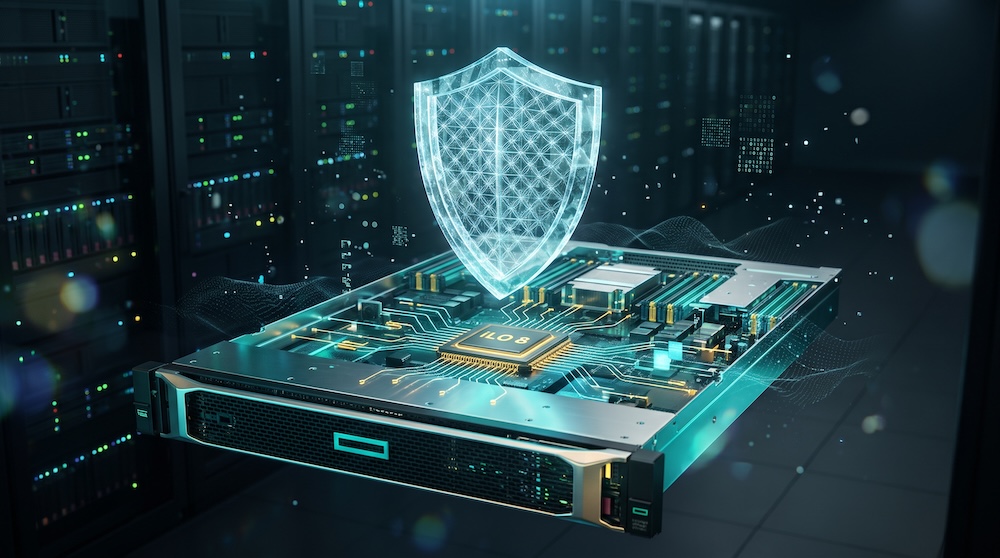
With HPE ProLiant Gen13 and HPE iLO 8, HPE has built post-quantum cryptography into the server’s hardware foundation. According to HPE, the silicon root of trust, which checks the firmware every time the server starts, now uses ML-DSA, the quantum-resistant signature standard that CNSA 2.0 requires. The TPM supports post-quantum algorithms, too. And the certificates that prove who the server is now use ML-DSA as well. This means each server’s identity is quantum-resistant from the factory floor. To be fair, the approach in HPE ProLiant Gen12 was already quantum-resistant, so this isn’t a fix for a weakness. It puts the root of trust on the same standard used across the rest of the server. (I walked through the full set of HPE ProLiant Gen13 post-quantum capabilities in my first Analyst Insight about the platform.)
HPE says it has also extended post-quantum protection to how the server is managed. That covers the connections that administrators and management tools use to reach HPE iLO 8, along with the checks the server runs to confirm that its components are authentic. Why does that matter? Because the management controller holds the keys to the kingdom. Anyone who can impersonate it, or slip a counterfeit component past it, can control the server below the operating system. Those component checks also work with older parts, which is important in a server full of third-party components that won’t all move to post-quantum at the same pace. For organizations that need to meet the federal standard, HPE also offers a dedicated CNSA 2.0 mode.
Crypto-Agility Is a Lifecycle Management Problem
Here’s the reality. No enterprise will convert its datacenter to post-quantum cryptography over a weekend, or even over a quarter or two. The transition will unfold over years, across mixed fleets, and alongside management tools, certificate systems, scripts, and monitoring platforms that still expect RSA and other traditional algorithms. Back in early 2025, I listed crypto-agility among five early steps toward a post-quantum-safe environment. NIST’s final report now calls for “building long-term cryptographic agility into organizational infrastructure.” In practice, that makes crypto-agility a lifecycle management discipline as much as a cryptography one.
HPE ProLiant Gen13 is designed for that kind of gradual transition. When both ends of a connection support it, the server combines quantum-resistant and traditional encryption. Older tools can still connect using traditional encryption where policy allows, though those connections don’t get post-quantum protection. HPE iLO 8 also lets IT choose from four security levels, up to CNSA 2.0, and run new quantum-resistant certificates alongside the ones organizations use today.
That flexibility introduces a challenge of its own. With different servers in different security states, someone has to keep track of which server is running what. Which systems are in CNSA 2.0 mode? Which remain in a transitional state, and why? Which HPE ProLiant Gen12 servers have received the updated libraries? Which tools are still connecting without post-quantum protection? As I argued in my last Analyst Insight, this is where management becomes a security control. With HPE Compute Ops Management, IT teams can centrally manage firmware updates using defined baselines, monitor configuration and compliance status, and see what has changed across distributed environments. That turns a cryptographic migration from a series of manual, server-by-server tasks into a consistent, centrally managed program. And because HPE Compute Ops Management supports HPE ProLiant Gen10 and newer servers, a mixed estate can move forward under a single operational model, from the older HPE ProLiant systems that many organizations will keep running through the transition to updated HPE ProLiant Gen12 and new HPE ProLiant Gen13 servers.
As an ex-IT leader, I can tell you that having a capability and proving you use it are two very different things. When the auditors show up, they’ll want to know three things. What can your servers do? How are they configured? And what are they actually using? Spec sheets and firmware inventories cover the first. Configuration compliance covers the second. The third requires visibility into the encryption actually in use. And none of it should come from a spreadsheet someone last updated in the spring.
What the Post-Quantum Transition Means for Infrastructure Buyers
The post-quantum deadline that makes the headlines is 2035. The one that matters for infrastructure planning is much closer, because the servers bought in the next refresh cycle will define what an organization can and can’t upgrade later. To be clear, quantum computers capable of breaking RSA aren’t here yet, and no one should panic-buy hardware because of them. But a refresh that’s already on the calendar is the least expensive moment to get post-quantum protection into the layers that can’t be retrofitted.
For existing HPE customers, HPE ProLiant Gen12 has a real path forward through firmware and library updates. For new deployments, HPE ProLiant Gen13 builds post-quantum cryptography into the root of trust, TPM, and server identity, extends it to management communications, and pairs it with the fleet management that a multiyear migration requires. HPE was first to bring silicon root of trust to industry-standard servers with HPE ProLiant Gen10 in 2017, and HPE ProLiant Gen13 applies that same build-it-in thinking to the post-quantum transition.
For CIOs and security leaders planning a 2027 refresh, post-quantum readiness belongs among the evaluation criteria alongside performance and efficiency. Ask which layers of the platform use post-quantum cryptography today, which can be upgraded later, what happens when a legacy tool connects, and how the fleet will be managed through the transition. On each of those questions, HPE ProLiant Gen13 has strong answers and is worth a close look.