AI has changed what enterprises need from a server. It’s no longer enough to add cores and call it a new generation. Today’s platforms have to deliver more performance inside fixed power envelopes, protect workloads that have become mission-critical, and run with less human intervention than ever before.
HPE’s answer is ProLiant Gen13. The first wave, built on 6th Gen AMD EPYC processors, combines HPE’s long server design heritage with lessons learned building the world’s largest supercomputers. It also extends a security lead that HPE has held since it introduced silicon root of trust nearly a decade ago.
These first two HPE ProLiant Gen13 servers, both built with AI workloads in mind, open what may be one of the most complete ProLiant launches in years. Here’s why.
AI Has Rewritten the Server Requirements List
Walk into any enterprise datacenter and you’ll find a workload mix that looks very different from just a few years ago. Virtualization and databases still run the business. But they now sit alongside inference engines, retrieval-augmented generation (RAG) pipelines, and agentic AI applications that act on the business’s behalf. This mix places four new demands on the server.
Power efficiency is now a first-order design principle. Power is the scarcest resource in most datacenters. Every watt saved in cooling, power delivery, and idle cycles is a watt that can feed the processors and accelerators doing the real work.
Servers must fully expose the latest silicon. CPUs now ship with hundreds of cores. GPUs demand more bandwidth and more power. A platform unable to feed these devices with enough memory capacity, memory bandwidth, and I/O leaves performance, and money, on the table.
Security has to start at the lowest levels. AI workloads touch sensitive data and drive core business processes. Firmware, components, and management controllers are all targets. Protecting the operating system alone isn’t enough.
Operations must be automated for resilience and reliability. IT’s mandate has shifted from break/fix to empowering the business. The tools IT teams rely on have to do more, go deeper, and act automatically. And this has to be done with the full confidence of the folks who used to perform these functions through scripts and consoles.
ProLiant Gen13 Is Built for AI and Secure by Design
HPE designed ProLiant Gen13 around these requirements. The company positions the portfolio as built for AI and secure by design, supporting everything from traditional virtualization to agentic AI. The first wave includes two new AMD-based HPE ProLiant Gen13 platforms, joined by two new HPE ProLiant XD servers.
The HPE ProLiant DL525 Gen13 is a 1U, single-socket system optimized for CPU-based AI inferencing, modeling, simulation, and virtualization. The DL585a Gen13 is an accelerator-optimized platform supporting up to eight double-wide GPUs for inference, visualization, fine-tuning, and agentic AI. It also powers the next generation of HPE Private Cloud AI. The HPE ProLiant XD245 and XD285 servers target CPU-intensive HPC and AI workloads.
Influenced by Supercomputing Thinking
While HPE describes the XD platforms as bringing supercomputing thinking to open compute, I’d argue that phrase captures the spirit of this entire launch. This is the company that built El Capitan, Frontier, and Aurora, the world’s first three exascale systems. Whether these platforms draw on Cray intellectual property, the engineering talent that made Cray a supercomputing leader, or both, the influence is easy to see. The XD245 is a four-node, direct liquid-cooled design built around a 40°C inlet requirement. The XD285 is its two-node, air-cooled sibling. Both use a 21-inch OCP rack architecture and support HPE Slingshot networking alongside Ethernet and InfiniBand.
AI is now pushing enterprise racks toward the power densities and liquid cooling that supercomputing centers have managed for years. These XD platforms run the supercomputing playbook, packaged for enterprises and research labs.
ProLiant Gen13 Performance and Efficiency
Under the hood, all the new ProLiant platforms are built to fully expose 6th Gen AMD EPYC. Processors scale to 256 cores and 600W. Memory runs 16 channels per socket, with DDR5 at up to 8,000 MT/s and MRDIMMs at up to 12,800 MT/s (up to 16,000 MT/s on the XD platforms). MRDIMMs access two memory ranks in parallel, effectively doubling bandwidth per slot. PCIe 6 doubles I/O bandwidth over the prior generation. For AI and HPC workloads that are more often starved for data than for compute, these gains matter.
Efficiency is where I think the design choices really show. HPE says the DL525 delivers up to 2x greater compute performance with improved efficiency in a secure, single-socket platform. For years, many enterprises bought two-socket servers by default. With up to 256 cores on one processor, single-socket is no longer an entry-level compromise. When one socket delivers the cores, memory bandwidth, and I/O that a workload needs, organizations can consolidate, reduce socket-based licensing costs, and reclaim power for accelerators.
The DL585a applies similar thinking at the GPU tier. Its dual-domain power design separates system board and GPU power, and its switchboard architecture lets customers adopt new GPU generations without redesigning their environments.
The outcome is more performance per rack unit and per watt. When power, not floor space, is the constraint, those are the metrics that count.
Security: HPE Led the Way, and the Industry Followed
The new HPE ProLiant servers are robust. A lot of this comes from HPE’s server and system design. Some of it is simply a matter of enabling the most advanced silicon to do what it does in an unfettered way. But I think security is where I see Gen13 standing out most. And it’s worth spending a few words on how HPE has led the market in this area.
In 2017, HPE introduced silicon root of trust with ProLiant Gen10. The idea was simple, yet powerful. HPE embedded an immutable fingerprint in its own iLO silicon, so a server won’t boot if its essential firmware has been tampered with. No one else in the industry-standard server market was doing this at the time. Today, nearly every server vendor talks about a hardware root of trust.
HPE led, and the market followed — but HPE didn’t stop there.
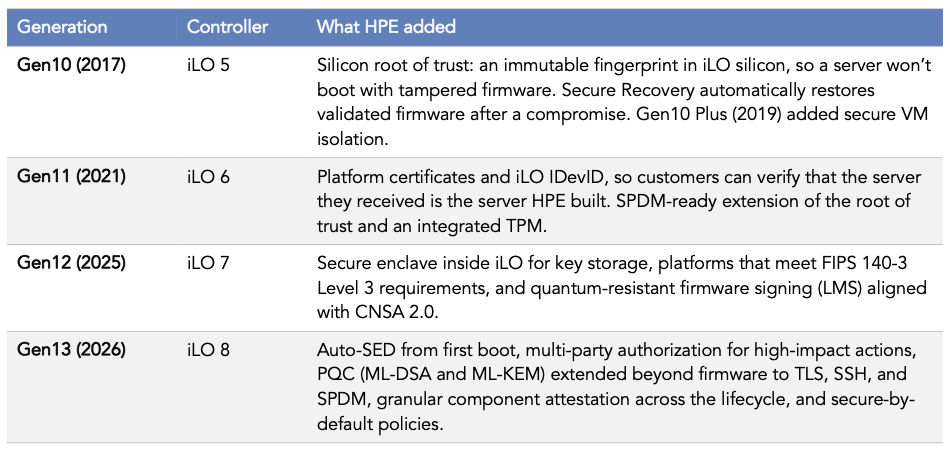
Underpinning every generation, HPE’s trusted supply chain and secure manufacturing practices protect servers before they leave the factory. This work is backed by more than 1,500 security patents, including approximately 400 compute security patents.
This brings us to HPE ProLiant Gen13 and HPE iLO 8. In this generation, HPE seems to take the next step, framing a modern security posture around four ideas: automatic protection, built-in governance, verified trust, and readiness for what’s next. I’m going to dig into each of these below.
Automatic protection. Self-encrypting drives have existed for years. The problem is that someone has to turn them on and manage the keys. And in the real world, many organizations never do. It’s like buying a car with a safety feature you never activate. HPE ProLiant Gen13 is the industry’s first server with automatic self-encrypting drive (auto-SED) capability. At first boot, HPE iLO 8 takes ownership of the drives, enables encryption, and stores the keys in the secure enclave. No external key manager or manual activation is required.
HPE also tightened defaults across the board. Secure Boot and component integrity checks are turned on out of the box, while legacy protocols such as IPMI over LAN are turned off. The result is a hardened posture from first boot, with nothing for IT to configure. Something enterprise IT organizations have long wanted.
Built-in governance. Human error remains one of the biggest security risks in IT. HPE iLO 8 introduces what HPE calls the industry’s first multi-party authorization at the server management level. High-impact actions, such as secure erase or key provisioning, require approval from a second authorized person. It’s the two-person rule, applied to the datacenter. Once administrators designate the second approver, iLO 8 enforces the policy automatically.
Verified trust. HPE ProLiant Gen13 servers expand component attestation across the full server lifecycle. HPE iLO 8 cryptographically verifies more components, including CPUs, PCIe cards, storage controllers, backplanes, and power modules. When a component is replaced or upgraded, iLO can reissue the platform certificate. The result is a running, verifiable record of what the server should be, from cradle to grave.
From PQC-Capable to PQC-Enabled
When discussing readiness for what’s next, post-quantum cryptography (PQC) deserves a bit more coverage. Quantum computers capable of breaking today’s public-key cryptography aren’t here yet. But adversaries are already harvesting encrypted data to decrypt once those quantum machines arrive. And regulators aren’t waiting. Under CNSA 2.0, new acquisitions for U.S. National Security Systems must support quantum-resistant algorithms starting January 1, 2027. And I see many commercial organizations using this timeline as their own roadmap.
When HPE launched ProLiant Gen12, it made ProLiant PQC-capable. iLO 7 used a NIST-approved, hash-based signature scheme (LMS) to sign firmware and verify it at secure start. That secured the most critical layer of the server.
With Gen13, ProLiant becomes PQC-enabled. iLO 8 moves to ML-DSA (FIPS 204) for signing and adds ML-KEM (FIPS 203) key exchange, the NIST standards that were finalized in 2024. It supports hybrid options that pair quantum-safe and classical algorithms, a dedicated CNSA 2.0 mode, and a PQC-enabled TPM.
Just as important, PQC protection now extends beyond firmware into TLS, SSH, and SPDM device communications. Why does that matter? Firmware signing protects what a server runs. But servers also talk: to management tools, to administrators, and between components. And each one of those paths is an attack surface. HPE is the first in the industry to extend PQC-enabled server protection beyond firmware.
In practical terms, Gen13 moves PQC from a firmware feature to a platform-wide trust model. And because customers can select security levels and maintain existing RSA and ECDSA certificates alongside new ones, they can modernize on their own timeline.
Put simply, Gen13 gives enterprise IT quantum-safe protection across the server platform, aligned with compliance deadlines already on the calendar, with no rip-and-replace required.
Management That Gives IT Its Time Back
Security rightfully gets the headlines. But system management is where IT teams spend their days. And this is another area where I see HPE ProLiant Gen13 leading.
If you’re not familiar, HPE Compute Ops Management is the cloud-based control plane for ProLiant fleets. Gen13 introduces advisory intelligence. This is an industry-first capability that uses agentic AI to evaluate new security and operational advisories against each server and prioritize the ones that matter most. Gen13 also introduces low-touch onboarding to minimize the work needed to bring new servers online. And power insights deliver rack-level power data at granular intervals so teams can plan capacity with real numbers.
If you look at these individually, they may seem incremental. But as an ex-IT leader, I can tell you that collectively, they go after the tasks that bog down skilled IT staff. Every hour returned is an hour that can go toward the AI initiatives the business is asking for. And that is a big return.
HPE is also integrating HPE Compute Ops Management with HPE OpsRamp Software for full-stack visibility and faster remediation. And it’s connecting server management to GreenLake Intelligence, its agentic AI framework for hybrid IT operations.
To me, this is probably the most important long-term story in the launch. HPE has assembled a deep set of security and management assets, from silicon root of trust and iLO to HPE Compute Ops Management and HPE OpsRamp Software. GreenLake Intelligence is the framework that can tie them together. Picture iLO 8 telemetry feeding HPE Compute Ops Management that then feeds agentic workflows, and those agents acting across compute, storage, and networking with a human in the loop.
That’s more than better server management. It’s the future of IT operations, and HPE is well positioned to lead it.
What ProLiant Gen13 Means for Enterprise IT
For enterprise IT leaders, HPE ProLiant Gen13 delivers on four fronts. Security improves at the source, because encryption, governance, and verification no longer depend on someone remembering to flip a switch. Resilience improves as lifecycle attestation and automated advisories catch problems before they become outages. Operational efficiency rises as routine tasks shrink, freeing skilled people for higher-value work. And performance density lets organizations get the most from every watt and every rack unit they already have.
HPE has spent nearly a decade setting the pace for server security. With Gen13, it’s applying the same discipline to power, performance, and operations. This first wave of Gen13 focuses on AMD platforms, with more to come.
The direction is already clear. HPE is putting its supercomputing experience to work on the problems enterprises face as AI moves into production.
This makes the HPE ProLiant Gen13 platform worth a long look.