Intel’s new Arc G3 processor series is an entirely new product line specifically made for handheld gaming. The company teased it a bit at CES 2026 during the Panther Lake (Core Ultra 3 Series) launch, but now it is generally available. The G3 comes in two SKUs, the base-model G3 and the G3 Extreme, with the latter having the full 12-core Xe3 GPU (B390) that is also found inside the highest-end Panther Lake SoCs, along with a slightly higher peak TDP of 35W.
This may be the first time that AMD faces real competition in the handheld space, because in previous generations Intel simply repackaged existing chips for handhelds and didn’t really offer a dedicated gaming part. Additionally, Intel is targeting significantly better battery life and graphical performance, which should help to move the entire form factor forward.
The Arc G3 Series Is Tailored for Efficiency and Performance
The combination of efficiency and performance is possible thanks to the two new Courage Cove performance CPU cores, eight Darkmont efficiency cores, and four Darkmont low-power efficiency cores, for a total of 14 cores on the CPU tile. This chip has two fewer performance cores than the high-end Panther Lake chips found in the Core Ultra 3 series. It also has two integrated Thunderbolt 4 ports instead of the standard four ports found on all Core Ultra 3 SKUs. All of these changes allow the SoC to be optimized for low power while still supporting high-performance cores when necessary.
The GPU tile, however, is the most powerful configuration, with 12 Xe3 cores. This delivers the kind of performance that has put Intel on the map with the Core Ultra 3 series, which I reviewed in the Samsung Galaxy Book6 Pro. The thermal design (TDP) is also configurable from 8W up to 35W (or 30W for the G3 non-Extreme), which is similar to AMD’s Z2 Extreme. The G3 non-Extreme SKU also reduces the GPU configuration to 10 Xe3 cores, with CPU and GPU clocks 100 MHz slower.
The Arc G3 Leverages Intel’s Latest GPU Software
While Intel didn’t talk up gaming much for the Core 3 Ultra series earlier this year, the company did show it to be very capable and competitive for integrated graphics. I believe Intel was saving the real gaming chops for the G3 Extreme and enabling those same features on a platform that would benefit the most from them. The two key features are XeSS (Intel’s own flavor of AI supersampling) and Endurance Gaming. Neither of these is new to the Arc G3 series, but they have been updated for the Xe3 generation of GPUs and help maximize performance per watt, which is especially noticeable in handhelds.
XeSS with multi-frame generation is very similar to what NVIDIA is doing with its own DLSS except (obviously) running natively on Intel’s own GPU hardware. Intel compares the G3 Extreme to AMD’s Z2 Extreme in many of its presentations, claiming frame-rate superiority across super resolution, frame-gen (FG), and multi-frame-gen (MFG) use cases. (AMD does not yet support MFG in FidelityFX Super Resolution.) Intel claims that XeSS with MFG is 2x smoother on average against the Z2 Extreme. Intel’s Intelligent Bias Control is also designed to help balance power between the CPU and GPU; Intel says this results in average FPS uplifts of 13% or more in games like F1 2025.
Endurance Gaming is probably one of the best features that Intel offers here, carried over from the last generation but getting real mileage in this new series. Endurance Gaming focuses on a capped frame rate of 30, 40, or 60 FPS and optimizes for power with the reduced frame rate. This reduces power consumption in games like Team Fortress 2 (TF2) from 22W down to 4W.
Besides the graphically simpler TF2, Intel showed Endurance gaming at Computex in the more graphically complex Grand Theft Auto V and the even more complex Forza Horizon 6. Without Endurance Gaming turned on, each of these titles could be played for about three hours on battery on the MSI Claw 8 EX. Once Endurance Gaming was turned on, this roughly doubled to almost six hours for Forza Horizon 6 and GTA V, while TF2 went up to almost 12 hours, thanks to a 30 FPS frame-rate cap. Intel is also working on precompiled shader distribution, a key feature that reduces load times by as much as 26x in games like God of War Ragnarök.
Testing Intel’s Performance Claims for the Arc G3
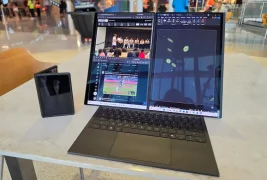
To dig deeper into performance specifics, I have acquired an MSI Claw 8 EX AI+ gaming handheld, which features the Arc G3 Extreme with MSI’s own cooling solution. I got to see this handheld at Intel’s Computex 2026 gaming suite, alongside others including the Acer Predator Atlas 8, the OneXPlayer 3, and a OneXPlayer convertible gaming tablet. I will be testing the MSI Claw 8 EX AI+ with the Arc G3 against the ASUS XBOX ROG Ally X with the Z2 Extreme — the closest competitor in-market today — to see how the performance stacks up. I’ll share those results in a future article.
While it’s exciting to see Intel target AMD’s dominant position in handheld gaming so directly, one downside for all of this are the ongoing pricing challenges for this category, which seem likely to persist as devices are priced in the $1,500 to $2,000 range amid ongoing memory and chip shortages. To take the handiest example, the MSI Claw 8 EX AI+, as I am testing it today, retails at $1,799 with 32GB of RAM and a 1TB SSD. I believe we’ve simply reached a point where pricing is going to be painful for the next few years — with predictable negative impacts on sales volumes.