Welcome to this edition of our Weekly Analyst Insights roundup, which features key insights our analysts have developed based on the past week’s events.
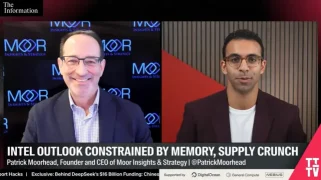
As an analyst who’s frequently asked to offer opinions, I don’t always get it right — and who could? — but sometimes I do see the writing on the wall. Last August, when Lip-Bu Tan left the Intel board, I tweeted my prediction that “we will hear again from Lip Bu Tan in regards to Intel.” Well, last week I was invited onto CNBC and Yahoo Finance to give my views about Tan’s appointment as Intel’s new CEO.
Of course, it’s too early to know for sure — he doesn’t even start on the job until Tuesday — but Tan has the uncommon pedigree for the position that I want to see. Anyone running Intel needs a combination of design experience (remember that he was CEO of Cadence for a dozen years) and fab/foundry experience. Beyond that, Tan is a semiconductor industry icon, so he unquestionably has the gravitas to be the CEO of Intel.

Three things are likely high on Tan’s agenda — or should be:
- Will there be a split between Intel’s IP and foundry businesses, and if so, when? I said last September that such a split didn’t make sense — at least at that moment. But the world has moved on since then, and Tan is ideally placed to assess this anew.
- Is there any way to accelerate the launch of a competitive GPU for AI in the datacenter? NVDIA of course owns that market right now, but while AMD has been making great strides in it, Intel has been limited to making optimistic projections about what it wants to do in that segment by late 2025 or 2026.
- Cost-cutting. This is painful to think about when Intel has just gotten rid of 15,000 employees, but are there more savings to be had on the fab side of the business?
So, is Tan the right pick? Both of the broadcast anchors asked me that, and I’ll repeat my answer here: I need to better understand Tan’s objectives and strategy to best assess it. In that vein, I’ve been busy getting comments from Intel’s biggest customers, which will continue as I round out my viewpoint. Plus, my best guess is that Tan won this appointment having already laid out his strategy for the board — so I expect we’ll hear more from him about it sooner than later.
For other viewpoints on this, be sure to read Matt Kimball under “Datacenter — Silicon” and Anshel Sag under “Semiconductors” in this week’s roundup.
The team has another busy week ahead. Matt is moderating a Synopsis panel in San Jose before joining Anshel and me at NVIDIA GTC, also in San Jose. Melody will be in Las Vegas for the Adobe Summit, and Will is headed to the Synopsis Executive Forum in Santa Clara.
On Wednesday, March 19, at 11:00 a.m. CST, Robert is co-hosting a discussion with SourceDay CEO Michael Miller on Shielding Your Supply Chain. The two will discuss why today’s supply chain volatility mirrors past crises, how AI, automation, and supplier performance monitoring reduce risk, and actionable steps to build supply chain resilience. Register here to check it out.
Stay tuned for our insights on these events, and be sure to follow MI&S on LinkedIn and X for more regular updates.
Hope you have a great week,
Patrick Moorhead
———
Our MI&S team published 25 deliverables:
Over the past week, our analysts have been quoted in top-tier publications, including Reuters, The Washington Post, Financial Times, PC Mag, InfoWorld, MediaTek, Wired, Computer World, Forbes, and BusinessWire. The media wanted our insights on Intel, HPE, OpenAI, Zoho, Databricks, Pure Storage, AI, devices, NPUs, and Google’s smart glasses.
Patrick joined Josh Lipton on Yahoo Finance and CNBC Overtime with Jon Fortt to discuss Intel’s appointment of Lip-Bu Tan as the company’s new CEO.
Check out this week’s Analyst Insights roundup for the latest from the MI&S team.
MI&S Quick Insights
It was a big week for ServiceNow, which released a major platform update codenamed Yokohama. The main thrust is upping the capabilities of the company’s already solid AI agent capabilities. Notably, this includes new developer tools and some improved guardrail and governance capabilities. Taking things one step further, ServiceNow also announced its intention to acquire Moveworks in what will be its largest acquisition to date. Moveworks will help ServiceNow build up its AI and agentic arsenal even more. I think that Moveworks brings some interesting products into the mix so that an active agentic feedback loop can be created. So instead of just speeding up people’s work, customers could also learn from how people interact with agents in ways that will help the customers improve their processes. ServiceNow has been aggressive about pushing agents in its bid to expand outside of the ITSM service domain. Stay tuned for some deeper research on this topic from me very soon.
OpenAI threw its hat into the agentic ring last week with a new API and other features. In many ways, the technology is similar to what we have seen from Anthropic’s agentic features. But I think this move is also telling in the sense that OpenAI may be trying to branch out into new use cases and respond directly to moves from its competition.
We keep hearing about organizations and individuals (potentially) working with hundreds or thousands of agents. But how will these agents be managed and how will we be able to understand their effectiveness? The short answer is: better agentic and AI governance. If agents are to become the new enterprise apps, enterprises will need to consider how to manage them across not only many platforms but also many different types of platforms. While we have seen some progress from the major cloud providers, last week Databricks made some interesting announcements that could prompt enterprises to consider a different approach.
It was a big week for ServiceNow, which released a major platform update codenamed Yokohama. The main thrust is upping the capabilities of the company’s already solid AI agent capabilities. Notably, this includes new developer tools and some improved guardrail and governance capabilities. Taking things one step further, ServiceNow also announced its intention to acquire Moveworks in what will be its largest acquisition to date. Moveworks will help ServiceNow build up its AI and agentic arsenal even more. I think that Moveworks brings some interesting products into the mix so that an active agentic feedback loop can be created. So instead of just speeding up people’s work, customers could also learn from how people interact with agents in ways that will help the customers improve their processes. ServiceNow has been aggressive about pushing agents in its bid to expand outside of the ITSM service domain. Stay tuned for some deeper research on this topic from me very soon.
OpenAI threw its hat into the agentic ring last week with a new API and other features. In many ways, the technology is similar to what we have seen from Anthropic’s agentic features. But I think this move is also telling in the sense that OpenAI may be trying to branch out into new use cases and respond directly to moves from its competition.
We keep hearing about organizations and individuals (potentially) working with hundreds or thousands of agents. But how will these agents be managed and how will we be able to understand their effectiveness? The short answer is: better agentic and AI governance. If agents are to become the new enterprise apps, enterprises will need to consider how to manage them across not only many platforms but also many different types of platforms. While we have seen some progress from the major cloud providers, last week Databricks made some interesting announcements that could prompt enterprises to consider a different approach.
Last year Sakana AI released an AI system that can independently run entire scientific research projects from start to finish. It is not like Google’s “co-scientist,” which must collaborate with a live scientist. The Sakana AI Scientist independently generates and selects research ideas, writes code, runs experiments, analyzes and visualizes data, and writes complete scientific manuscripts. It even performs simulated peer reviews to evaluate its findings and iteratively improve its work, closely mimicking the human scientific process.
The AI Scientist is proficient in machine learning, diffusion modeling, transformer-based language modeling, and learning dynamics. It is remarkably efficient and can produce complete scientific papers for around $15 each.
What brings this up now? Last week the company announced that a research paper created by the latest version of this system, AI Scientist-v2, passed the peer-review process at a machine-learning workshop that was part of the recent International Conference on Learning Representations. This was the first time that an AI-generated paper was able to pass a peer review. That is a good indication that future generations of models created using Sakana’s methodology could accelerate discovery through enhanced model creativity. In fact, the AI Scientist has demonstrated several signs that it is approaching artificial general intelligence (AGI). Those signs include autonomy, creativity, adaptability, and iterative self-improvement.
This is a company I will continue to cover. I’m looking forward to seeing the next version of AI Scientist and its capabilities.
Google has added several AI-powered features to its Customer Engagement Suite, focusing on improving conversational agents and contact center functionality. The updates include new voice models for more human-like AI interactions, a consolidated platform for developing hybrid agents, and preconfigured agents for everyday tasks. Data connectors have been expanded to integrate with various business systems. For employee support, AI-driven coaching and training tools are now available. Contact center enhancements include co-browsing for agents to view customer screens, customizable reporting dashboards, and a standalone agent desktop application.
These additions aim to give users more tools for managing customer interactions and improving operational processes. The company also reported some business impact numbers from several customers with significant ROI; the numbers show operational improvements from the Customer Engagement Suite, including reduced wait times, faster time to resolution, and few abandoned calls. I think that as AI starts to handle many common inquiries, these metrics will become less important, and metrics such as customer satisfaction, containment rate (how often the AI can handle the issue without escalating to a human), compliance and accuracy rate, and operational cost reductions will be more of the gold standard in CX.
Broadcom had a very strong earnings showing for Q1 FY2025, reporting $14.9 billion in total revenue (up 25% year over year). Its infrastructure software revenue, which includes VMware, was an accelerant to this growth, showing a 47% YoY increase to $6.7 billion. Finally, the company saw a 77% YoY increase in AI revenue from its custom silicon business.
A few quick thoughts:
- The performance of Broadcom’s custom and semicustom silicon business further reinforces the value that hyperscalers are recognizing in consuming bespoke chips for bespoke environments. In the same vein, we saw incredibly strong results from Marvell a couple of weeks back.
- This explosive growth makes one wonder if the commercial silicon vendors are looking back at the cost of their missed opportunities to respond in some way other than the traditional “knob tuning” that passes as custom.
- Switching to software, I am more interested to see if these strong numbers (specifically for VMware) will continue over the next several quarters. Broadcom has done a very effective job of locking in its existing large enterprise customers for license renewals. However, these very same customers are actively pursuing migration options and strategies.
- As Nutanix has benefited from the commercial enterprise and SMB move away from VMware, I believe larger enterprises will embrace cloud-native as the primary landing target for migration, continuing to use virtualization environments for legacy and corner cases. This is especially true as enterprise AI adoption accelerates and is driven by containerization.
There is a whole lot of chatter around Intel’s hiring of Lip-Bu Tan. While I think folks like our esteemed Pat Moorhead are able to give well-informed opinions, most of the rest of what I’ve seen/heard/read is noise. Here’s my very quick take:
- I was a big fan of Pat Gelsinger — and still am. As a leader and as a person.
- From a business perspective, Gelsinger had what I thought was a good strategy. And the product competitive issues the company had were addressed under his leadership.
- From a culture perspective, I think he was turning the ship. I also think he had too much “connective tissue” to the organization to bring about change faster.
- Lip-Bu Tan, though he was on the board, does not have that same connection. He was close enough to the business to see the warts, but he was far enough away to bring about that change faster.
- I think Tan is going to be highly focused on delivering value to shareholders. Period. This may make him unpopular internally (or not). But he will reshape the company effectively.
That’s my two cents — and feel free to call me just another pundit.
On March 11, Pure Storage announced the FlashBlade//EXA, which it classifies as the most performant and cost-effective data storage platform. FlashBlade//EXA disaggregates data storage from metadata storage, enabling organizations to achieve what Pure calls “nearly unlimited scale” without introducing complexity and latency. The FlashBlade//EXA is designed to bring Pure up the performance stack to compete more effectively in the AI/HPC market against the VAST Data Platform, as well as offerings from Dell, HPE, Lenovo, IBM, Weka, DDN, and others.
I see Pure targeting customers from hyperscalers all the way down the segment to enterprise AI deployments. We know that Pure recently won a hyperscaler — Meta, though not with this specific product — and the company undoubtedly took some learnings from its hyperscale interactions to inform decisions for FlashBlade//EXA.
Pure has leaned into three distinct areas of value when talking about FlashBlade//EXA: performance, simplicity, and cost. From a performance perspective, it has lifted a page from the VAST playbook by being very aggressive and bold in its claims. In fact, the company is claiming industry leadership in terms of read performance and density.
When talking about simplicity, Pure is drawing heavily on its enterprise storage roots by claiming to abstract so much of the complexity associated with high performance storage for AI and HPC — much like it has done in the past. This is in stark contrast to what we’ve seen from some of the specialized storage players. A little deeper on the simplicity front, Pure is claiming to deliver all of this performance and complex metadata management support while abstracting complexity via its Purity//FB OS. While simplicity is a hard metric to quantify, Pure has an established reputation for driving simplicity across its portfolio of storage solutions.
Finally, in terms of cost Pure is claiming that FlashBlade//EXA delivers the most compelling TCO in the market. Further, FlashBlade//EXA will be made available to consume under a traditional/legacy CapEx model or an as-a-service model via the company’s Evergreen//One offering.
One more interesting note: this marks the first time Pure has enabled third-party hardware for its solutions (data nodes run Pure’s software on commodity servers).
My thoughts: Pure has jumped into the AI storage gold rush along with the likes of VAST and other “newcomers” that are looking to take share from traditional storage players. Unlike some of the competition, Pure has done a stellar job of establishing itself as a general-purpose enterprise storage play. While some of the specialized players are seen as overly complicated and costly, Pure has built a strong enterprise presence focused around the very same value pillars that it is using for FlashBlade//EXA — performance, simplicity, cost. And the company’s success has indeed come at the expense of the legacy storage solutions already on the market.
Here’s the thing. As enterprise AI reaches mainstream adoption, it will become just another workload to IT. Yes — hugely transformational. And yes, perhaps driving unprecedented efficiency. But in order to thrive, AI has to be easier for an enterprise IT organization to deploy, provision, and manage. And while it may be cool to be first and ride the top of the hype cycle, what wins in the end is what is most consumable while meeting the needs of the customer. And this is why Pure’s competitors should take note of what the company is doing.
ServiceNow has announced its acquisition of Moveworks for $2.85 billion — the largest acquisition it has ever made. CEO Bill McDermott describes this as a “tuck-in” acquisition due to the integration plans for Moveworks’ AI assistant and enterprise search technology into ServiceNow’s platform. Notably, 500 AI leaders from Moveworks will join ServiceNow under long-term retention agreements.
Key points include:
- The integration aims to provide a unified AI experience across enterprises, enhancing efficiency by bridging traditional departmental silos.
- Moveworks boasts a high customer adoption rate, with 90% of users deploying the technology across their entire organizations.
ServiceNow is shifting how companies will look at organizational structure. The end-to-end search and self-service extraction layer could bridge traditional departmental silos. The AI agents should allow employees to access information and automate tasks across different workflows from a single entry point. This is more than a time saver/productivity issue. It could minimize organizational risk with consistent data, policies, and governance.
ServiceNow’s focus on using technology as a deflationary force to drive business efficiency places it well in a market where companies are looking to do more with less. The company’s marketing must strike a balance of sensitivity and reality, but it is a massive opportunity.
Meanwhile, ServiceNow made another step in its shift from workflow automation to AI-powered processes with its Yokohama platform update. This update introduces preconfigured AI agents for key business functions including CRM, HR, and IT. Notably, it allows companies to connect digital workforce performance to KPIs such as case deflection rate, automation adoption, ROI, and employee productivity, enabling users to fine-tune AI agents based on their effectiveness. With the Yokohama update, AI Agent Orchestrator and AI Agent Studio are now generally available. Given its expanding focus on CRM, ServiceNow aims to enhance complex service delivery and enterprise-wide data integration, setting itself apart from traditional CRM systems.
It’s refreshing to see these ServiceNow announcements emphasize business value over mere features. I’m eager to see actual use cases and customer ROI demonstrating this impact. The Moor Insights & Strategy team is taking a closer look at these developments, so stay tuned for more insights.
ServiceNow’s acquisition of Moveworks is a great move given the importance of data and AI today. This deal should make it easier for ServiceNow users to find and use data across different enterprise systems. By adding Moveworks’ AI assistant to its platform, ServiceNow creates a more automated way to access information without jumping between apps, which could lead to less time wasted searching for data. Data is such an important component for all businesses, and it’s the key to AI success. In the long run, this deal can improve data management by centralizing data access and increasing productivity as AI takes on more repetitive tasks.
Broadcom recently introduced its VeloSky converged appliance for fiber, 5G, and low earth orbit satellite connectivity. It is designed to help communication service providers drive enterprise adoption and monetization of converged connectivity services. The power of VeloSky lies in its ability to provide a single link to enterprises that can facilitate traffic prioritization, bandwidth management, improved security features, and simplified operations. Given the latency and throughput demands of modern applications including generative and agentic AI, Broadcom’s latest offering has great potential.
Many security firms focus on SaaS applications, but ERP systems particularly need extensive security. Cybercriminals are taking advantage of unpatched vulnerabilities, insecure configurations, and gaps in custom code. Traditional security tools like firewalls and access controls aren’t enough to stop sophisticated attacks at the application level. This puts businesses at risk of financial fraud, ransomware, and operational disruptions. Unfortunately, as more ERP systems move to the cloud, security gaps are getting wider. Many organizations think their SaaS providers handle all security, when in fact they themselves are still responsible for protecting their own applications and data.
There are vendors that address these risks with a proactive approach. They offer continuous monitoring, real-time threat detection, and application-layer defenses. Onapsis is one of many cybersecurity companies that offer ERP security protection. Other solutions include ERPScan, Protect4S (a SecurityBridge company), SAP Enterprise Threat Detection, Qualys, Fortinet, and Palo Alto Networks. Splunk provides security analytics, and Oracle Security Tools and SUSE NeuVector offer built-in security features. Regardless of the solution chosen, research shows a rise in ERP-targeted cyberattacks, so companies need to prioritize security in this area from the start.
The automotive industry is going through major supply-chain-related shifts in 2025. Europe is dealing with overcapacity, forcing manufacturers to face tough decisions on how to stay competitive. China has become the top vehicle exporter, significantly impacting global markets. Companies everywhere are feeling the pinch from rising costs, leading them to rethink their plans and explore new trade routes. Plus, there’s this growing trend of bringing production closer to home, which is totally changing the way supply chains work. At the same time, automakers are under pressure to cut costs and improve efficiency as they shift toward EVs. Many are looking to local production — especially for EV batteries — to reduce logistics costs and support sustainability goals. All of these factors make this a period when it’s even more important for automakers to ensure that they’re getting the most out of their SCM deployments to ensure efficiency and inform wise decisions.
Epic’s announcement that Snapdragon on Windows PCs will be able to run Fortnite and get support for Easy AntiCheat should continue to help the compatibility issues the platform has had with games. Paired with support for AVX, this should mean that a lot more games will likely run a lot smoother, and those that previously simply wouldn’t run will run now. Fortnite is also the perfect game for a platform like the Snapdragon X series because it’s not very graphically intensive, yet it’s still a very popular cross-platform title. The timing is also good, as this announcement comes just in time for the GTC show this week.
Qualcomm and Edge Impulse: We’re seeing rapid growth of AI applications on edge devices, and Qualcomm is hitting the gas. Last week, Qualcomm agreed to buy Edge Impulse, a leading provider of AI development tools for building, tuning, and deploying AI models on a wide variety of small edge systems — both MCU- and MPU-based. But that’s only part of the story. For the past year, Qualcomm has been running a much bigger strategy consisting of these four components:
- A mature portfolio of industrial-focused SoCs
- Industrial embedded Linux OS tools and services (Foundries.io, acquired March 2024)
- An AI development framework for edge devices (Edge Impulse, acquired March 2025)
- The new Dragonwing umbrella brand (which Patrick covered in his writeup on Qualcomm’s announcements at MWC)
The result is a comprehensive industrial IoT platform that enables developers to transition from do-it-yourself, highly customized mashups of tools, chips, and system code to a high-productivity, application-focused model comparable to PCs, mobile devices, and other mainstream products.
Qualcomm and Palantir: The Dragonwing story gets even better with last week’s Palantir collaboration announcement. Palantir is extending its Ontology operations data integration package to Dragonwing edge systems, even in remote, air-gapped industrial environments.
My take: This is a compelling digital business transformation story. Qualcomm is firing on all cylinders, combining a reality-based long-term technology vision with mature industrial SoCs, savvy software acquisitions, AI partnerships, and solid execution. However, I hope the company does not lose sight of the extreme diversity of operational (IIoT) systems. At Embedded World 2025, Edge Impulse CEO Zach Shelby said, “There are five exhibit halls and thousands of vendors. That’s the world of embedded systems.” He’s right. A closed ecosystem is a tough sell in this environment. The Dragonwing software tools should remain multivendor.
NXP announced the S32K5 family of automotive microcontrollers, the first 16nm FinFET MCU with embedded magnetic RAM (MRAM). As with other CoreRide chips, NXP designed the S32K5 series to enable software-defined vehicles (SDVs) with zonal architecture, replacing many single-function control modules scattered around the vehicle with a few centrally-located multi-function modules. SDVs require a new generation of automotive SoCs with larger, specialized processors capable of real-time multitasking. MRAM is a good choice for SDV memory for two reasons. First, it’s much faster than other non-volatile memory technologies. NXP claims that MRAM can update 20MB of code in about 3 seconds, while flash requires about a minute. Second, MRAM doesn’t “wear out” like flash. Durability is essential because vehicles are often in service for decades.
Vodafone and Ericsson have divulged a successful trial that the two companies implemented in the U.K. In this trial, Ericsson’s AI-accelerated software and RAN demonstrated colossal 30% savings on 5G power consumption. When you consider that power consumption is an operator’s largest cost, it makes a lot of sense why reducing that cost by 30% could be very attractive for operators around the world running or considering Ericsson equipment.
ViaSat has agreed to explore D2D satellite solutions with UAE-based Space42, a new satellite company working to accelerate the implementation and growth of space technology in the Middle East and beyond. ViaSat has already signed a similar agreement with the European Space Agency, since that organization has the satellite know-how and multiple constellations up in orbit already. ViaSat’s latest technology powers many broadband technologies currently running on commercial planes.
IonQ provides quantum computers and quantum networking products. It just raised about $360 million using a process called an “at-the-market” (ATM) equity offering. ATM is a process used to sell new shares directly to the market on a gradual basis rather than dumping all 16 million shares into an unstable market all at once. IonQ ended the ATM once it felt it had met its fundraising goals. Although IonQ executives were able to sell their shares until March 14, 2025, the company said that no one planned to do that other than Peter Chapman, who recently transitioned from CEO to executive chair. Chapman was planning to sell around 2 million shares to fund a personal real estate purchase.
A few insights: IonQ’s new CEO, Niccolo De Masi, played a key role when IonQ transitioned from being privately held to being a public company, and he has served as a member of IonQ’s board of directors since September 2021. The recent ATM sale shows he continues to provide important financial leadership by determining how and when IonQ raises money. Ending the ATM is a move that aligns with De Masi’s past focus on shareholder value, maintaining investor confidence, and ensuring IonQ remains well-positioned financially. With the additional $360 million, IonQ has about $700 million available to fund its operations and pursue growth opportunities.
A recent report published by cyber insurance firm Coalition indicates that a majority of ransomware claims involved the compromise of VPNs and firewalls. I recently weighed in on the vulnerabilities tied to firewalls in a Moor Insights & Strategy Analyst Insight, and the Coalition report reinforces my thinking from that piece. Broadly speaking, firewalls serve as homing beacons for exploitation by bad actors. From my perspective, tools that mask attack surfaces and networking infrastructure serve as the best line of defense.
Intel’s appointment of Lip-Bu Tan perhaps indicates that there simply weren’t many people more qualified than Pat Gelsinger to run the company — and Tan was the next natural option. While I didn’t agree with the removal of Gelsinger, which I thought was premature, I do believe that Tan is the most experienced and capable person to execute Intel’s strategy. The biggest and unanswered question is whether he will remain on the same course as Gelsinger, keeping product and foundry under one company. Also, it will be interesting to see where Intel chooses to grow and where it plans to cut under Tan’s leadership. The 18A production node and the Panther Lake processor family both seem very much on track and should deliver considerable improvements to Intel’s profitability and competitiveness.
AMD’s launch of the Ryzen 9 9950X3D demonstrates that the company truly has CPU leadership, and with the improved 3-D V-Cache 2.0 design, the company is able to deliver not only the fastest CPU for gaming but also the fastest CPU for productivity. While the 9800X3D may edge it out in some games by a few frames per second, the 9950X3D is able to deliver considerably better productivity performance with essentially the same gaming performance. As someone who likes to edit photos and videos as well as game on the same machine, the 9950X3D is the perfect balance of those things — while also not breaking the bank at $699.
The big UC show Enterprise Connect started today, and some announcements have already been made. Zoom introduced new AI-driven features for its AI Companion, including calendar management, clip generation, writing assistance, and task automation. The updates also include an enhanced virtual agent capable of complex issue resolution, customizable virtual agent creation, a specialized sales agent, and the ability to interact with third-party agents. These additions aim to provide users with tools for managing tasks and interactions within the Zoom platform.
RingCentral announced two AI-driven solutions for its RingCX customers. AI Interaction Analytics aims to analyze customer sentiment by processing all customer interactions and generating inferred customer satisfaction scores. This data is displayed in a dashboard format, including factors affecting satisfaction and agent performance metrics. AI Interaction Analytics will be available in beta in Q2 2025, with general availability soon after. The company also announced updates to AI Agent Assist and AI Supervisor Assist. Agent Assist provides real-time contextual suggestions to customer service agents during interactions, drawing from company resources. Supervisor Assist monitors interactions to identify issues requiring intervention and provides summaries and transcripts for review. Both updates are now in beta testing, with general availability slated for the coming months.
There will be many more announcements from vendors throughout the week, and although I cannot be at EC in person this year, I have been pre-briefed on many of them and will be capturing and weighing in on the news from afar. Stay tuned for more.
T-Mobile is readying its plans to introduce 5G Advanced within the United States. The published 3GPP standards related to 5GA are somewhat vague, but the carrier is incorporating carrier aggregation, 5G reduced capacity, and L4S technology designed to reduce network latency and data packet loss within its deployment plans. T-Mobile has enjoyed a leadership position with its Standalone 5G core, and its 5GA ambitions are another barometer of its network technology leadership.
Forbes Articles Published
Research Notes Published
- Dell’s Premium Approach to Gaming Peripherals with the Alienware Brand (Anshel Sag)
- Siemens Datacenter Analyst Summit Recap (Matt Kimball)
Analyst Insights Published
- Amazon Alexa+ — Empowering The Agentic AI Era At Home (Anshel Sag, Patrick Moorhead)
- NTT DATA’s Strategy To Accelerate Private 5G Network Adoption (Will Townsend, Patrick Moorhead)
- HP’s 2025 PC Lineup: New CPUs And GPUs Showcased In Updates Galore (Anshel Sag, Patrick Moorhead)
- Beyond Videoconferencing: Zoom’s Strategic Investment In Healthcare AI (Melody Brue, Patrick Moorhead)
- Evaluating Lenovo PCs For Consumer And Commercial Market For 2025 (Anshel Sag, Patrick Moorhead)
- Lenovo’s Gaming Lineup For 2025: How Does It Stack Up? (Anshel Sag, Patrick Moorhead)
- Transforming Telecom Operations Through Agentic And Generative AI (Will Townsend, Patrick Moorhead)
- What Does Apple’s $500 Billion Pledge For U.S. Production Really Mean? (Patrick Moorhead)
- What Could Merging The IBM And Red Hat Middleware Teams Accomplish? (Jason Andersen)
- MI&S Weekly Analyst Insights — Week Ending March 7, 2025 (MI&S Analyst Team)
Podcasts Published
DataCenter Podcast (Will Townsend, Paul Smith-Goodson, Matt Kimball, Patrick Moorhead)
G2 on 5G (Will Townsend, Anshel Sag)
Six Five (Patrick Moorhead)
- Navigating Market Volatility: Tech Moves and Looming Tariffs — Six Five Episode 253
- Securing Your Data: Future-Proofing Server Security in the Quantum Computing Era – Six Five On The Road
- AI and The Future of Quantum: A Conversation with IBM CEO Arvind Krishna at SXSW 2025
- Vodafone and IBM Work to Future-Proof Smartphone Security with Quantum-Safe Cryptography – Six Five On The Road
- The Future of IOWN – Enabling a New Infrastructure Beyond the Limits of Current Technology
- Network Evolution for Business Model Innovation – Six Five On The Road
- What’s Driving the Next Wave of Mobile – Six Five Media from MWC 2025
- Lenovo’s Smarter AI for All: Enhancing How the World Works, Creates, and Connects – Six Five Media at MWC Barcelona
- The Six Five: Talking MWC, Salesforce, Broadcom, Marvell, HPE, Tariffs & Tech
Don’t miss future MI&S Podcast episodes! Subscribe to our YouTube Channel here.
Press Citations
Intel / New CEO / Patrick Moorhead / Financial Times
New Intel chief cheered by investors after board sought alternatives
Intel / New CEO / Patrick Moorhead / The Washington Post
Intel names new CEO to help reverse chipmaker’s struggles
Intel / New CEO / Patrick Moorhead / Reuters
Intel appoints chip industry veteran Lip-Bu Tan as CEO
Intel / New CEO / Patrick Moorhead / PC Mag
Intel Names Former Board Member Lip-Bu Tan as Its New CEO
Intel / New CEO / Anshel Sag / Reuters
Intel appoints chip industry veteran Lip-Bu Tan as CEO
Intel / Trump, Tariffs, Chip Designers / Patrick Moorhead / Fierce Electronics
What’s real with Intel/TSMC, CHIPS Act billions and tariffs?
AI / AI Technologies / Anshel Sag / MediaTek
The Technologies Making AI Even Smarter
Databricks / AI apps / Jason Andersen / InfoWorld
Databricks’ new updates aim to ease gen AI app and agent development
Devices & FTC / Consumer Financial Protection Bureau / Anshel Sag / Wired
Companies Might Soon Have to Tell You When Their Products Will Die
Google / Smart Glasses / Anshel Sag / Computer World
Google reportedly looking at smart glasses — again
HPE / AI / Will Townsend / ITBrief
HPE unveils new telco networking solutions with AI focus
NPUs / Anshel Sag / Forbes
What The Rise Of NPUs Means For The Future Of Compute Power
OpenAI / API & SDK / Jason Andersen / InfoWorld
OpenAI takes on rivals with new Responses API, Agents SDK
Pure Storage / FlashBlade//EXA / Matt Kimball / Pure Storage
Pure Storage Introduces FlashBlade//EXA™, the World’s Most Powerful Data Storage Platform for AI and High-Performance Computing
Pure Storage / FlashBlade//EXA / Matt Kimball / DQ Channels
Pure Storage Unveils FlashBlade//EXA for AI and HPC
Pure Storage / FlashBlade//EXA / Matt Kimball / ITBrief
Pure Storage unveils FlashBlade for AI & HPC workloads
Zoho / Projects Plus / Melody Brue / BusinessWire
Zoho Launches Projects Plus, a Unified, Data-Driven, and AI-rich Project Management Platform Empowering Mid-sized and Enterprise Organizations
TV/BROADCAST APPEARANCES
Intel / New CEO / Patrick Moorhead / CNBC
Intel New CEO
Intel / New CEO / Patrick Moorhead / Yahoo Finance
Intel names tech veteran Lip-Bu Tan as new CEO
New Gear or Software We Are Using and Testing (New)
- 2.0 Antec Flux Pro Case
- 2.1 GeForce RTX 5070 and 5070 Ti
- Eve Systems dimmer switch – Matter-based and Thread-connected (Bill Curtis)
- Sony CRE-C20 OTC Hearing Aids (Anshel Sag)
- Sony 400-800mm f/6.3 G Lens (Anshel Sag)
- Steelseries Arctis Nova Pro Wireless Headset (Anshel Sag)
- iContact Camera Pro (Melody Brue)
- Lenovo ThinkPad X9 (Anshel Sag)
- HP EliteBook X G1a (Anshel Sag)
- Kindle Colorsoft (Anshel Sag)
- XREAL One AR Glasses (Anshel Sag)
- Insta360 Link2 4K AI Webcam (Anshel Sag)
- Various Matter devices (Bill Curtis)
- ASUS Zephyrus G16 Gaming Laptop (Anshel Sag)
Events MI&S Plans on Attending, in Person or Virtually (New)
Unless otherwise noted, our analysts will be attending the following events in person.
- NVIDIA GTC, March 17-21, San Jose (Patrick Moorhead, Anshel Sag, Matt Kimball)
- Adobe Summit, March 18-20, Las Vegas (Melody Brue)
- Synopsys Executive Forum, March 19, Santa Clara (Will Townsend)
- Zendesk Analyst Day, March 25, Las Vegas (Melody Brue)
- Oracle Database Summit, March 25, Mountain View (Matt Kimball)
- IBM Infrastructure Analyst Summit, March 25, NYC (Patrick Moorhead, Matt Kimball, Melody Brue)
- Intel Vision, March 29-April 1, Las Vegas (Matt Kimball)
- Microsoft FabCon, March 31–April 2, Las Vegas (Robert Kramer)
- NVIDIA GTC, March 17-21, San Jose (Patrick Moorhead, Anshel Sag, Matt Kimball)
- Adobe Summit, March 18-20, Las Vegas (Melody Brue)
- Synopsys Executive Forum, March 19, Santa Clara (Will Townsend)
- Zendesk Analyst Day, March 25, Las Vegas (Melody Brue)
- Oracle Database Summit, March 25, Mountain View (Matt Kimball)
- IBM Infrastructure Analyst Summit, March 25, NYC (Patrick Moorhead, Matt Kimball, Melody Brue)
- Intel Vision, March 29-April 1, Las Vegas (Matt Kimball)
- Microsoft FabCon, March 31–April 2, Las Vegas (Robert Kramer)
- MediaTek Analyst Day, April 2-4, Coronado (Will Townsend)
- Canva Create & Analyst Day, April 8-10, Los Angeles (Melody Brue)
- Infor Analyst Innovation Summit, April 8-9, NYC (Robert Kramer)
- NTT Upgrade, April 9-10, San Francisco (Will Townsend)
- Google Next, April 9-11, Las Vegas (Jason Andersen, Robert Kramer)
- Appian World, April 27-30, Denver (Robert Kramer)
- RSA Conference, April 28-May 1, Las Vegas (Will Townsend)
- Oracle Analyst Summit, April 29-30, Redwood, CA (Robert Kramer, Melody Brue)
- Blue Yonder ICON Summit, May 4 – 7th, Nashville (Robert Kramer)
- IBM Think, May 5-8, Boston (Patrick Moorhead, Jason Andersen, Robert Kramer)
- Oracle CloudWorld Tour, May 6, New York City (Robert Kramer, virtual)
- Nutanix.NEXT, May 6-9, Washington DC (Matt Kimball)
- Informatica World, May 13-15, Las Vegas (Robert Kramer)
- Fastly Accelerate, May 14, Los Angeles (Will Townsend)
- SAP Sapphire, May 19-21, Orlando (Robert Kramer) (Melody Brue – virtual)
- Red Hat Summit, May 19-21, Boston (Jason Andersen)
- Dell Tech World, May 19-22, Las Vegas (Matt Kimball)
- Extreme Networks Connect, May 19-22, Paris (Will Townsend)
- Hitachi Digital Services Analyst and Advisor Connect, May 20-21, Dallas (Bill Curtis)
- Zoom Perspectives, May 28-30, San Jose (Melody Brue)
- Cisco CX Analyst Day, May 29-30, New York City (moved from April in Atlanta) (Will Townsend)
- Zscaler Zenith Live, June 2-5, Las Vegas (Will Townsend)
- Snowflake, June 2-5, San Francisco (Robert Kramer)
- Broadcom Mainframe Software Analyst Summit, June 3-4, Cambridge (Matt Kimball)
- Augmented World Expo (AWS), June 10-12, Long Beach (Anshel Sag)
- Cisco Live US, June 8-12, San Diego (Will Townsend)
- AWS re:Inforce Summit, June 15-18, Philadelphia (Jason Andersen)
- HPE Discover, June 23-26, Las Vegas (Will Townsend, Matt Kimball)
- AWS GenAi Summit, July 14-16, New York City (Jason Andersen)
- Cloudera EVOLVE25, Sept 24-25, New York City (Robert Kramer)
- Webex One, September 28 – October 1, San Diego (Melody Brue)
- Techritory, October 22-23, Riga (Will Townsend)
- Oracle CloudWorld October 13-16, Las Vegas (Robert Kramer)
Subscribe
Want to talk to the team? Get in touch here!