Welcome to this edition of our Weekly Analyst Insights roundup, which features the key insights our analysts have developed based on the past week’s events.
It seems like every week now there is a big piece of AI news — or more than one — to keep the tech industry on its toes. On the heels of the $500 billion announcement of the Stargate project, which our analysts Paul Smith-Goodson and Matt Kimball wrote about last week, came the debut of DeepSeek, the open source AI which its makers say can outperform ChatGPT. (Sam Altman disagrees.)

I was invited to comment on CNBC and Yahoo Finance (links below) about DeepSeek — and about the uncertainties it creates and the sometimes hair-trigger reactions to it in the marketplace. Technology like this could well drive down AI costs, maybe dramatically, which would be good for both consumers and business customers in the long run. But there are also many unknowns. Matt Kimball and Anshel Sag both have comments on DeepSeek in their weekly updates below, and you can expect us to continue unpacking the implications of it — for AI training, inferencing, security, privacy, and more — going forward. Naturally, these kinds of advances will benefit some vendors in the AI space more than others over time, and we’ll keep you up to speed on all of that.
This week, Mel and Robert are attending ZohoDay in Austin, and our analysts as a group have a busy February of travel. We’ll be Oracle NetSuite SuiteConnect, Cisco Live EMEA, the SAP Analyst Innovation Council, RingCentral Analyst Summit, the Microsoft Threat Intel Summit, Siemens Datacenter Analyst Summit, and Edge AI. Check out our full calendar of events for the rest of the year (that we know of so far) and reach out to connect at any of these events if you’ll be there too!
Hope you have a great week,
Patrick Moorhead
———
Our MI&S team published 32 deliverables:
Last week was heavy on tech news, with many big tech company earnings and the continued news cycle from DeepSeek’s AI breakthrough, among other things. MI&S analysts were asked for our insights for stories in top-tier publications such as The New York Times, Business Insider, The Street and Yahoo Finance. The media also wanted our thoughts on Amazon, Dell, Endor Labs, Intel, Marvell, Meta, Micron, and Microsoft.
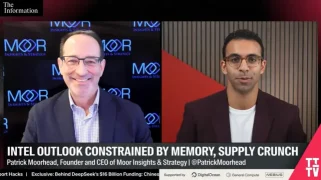
In addition to our insights shared in print publications, Patrick was a guest on CNBC and Yahoo Finance to discuss DeepSeek’s influence on the AI market. He also added commentary to Intel earnings on CNBC.
Robert was a guest host on Analysts Gone Wild, Analyzing Enterprise Software Stories, discussing acquisitions, ERP, AI, and more. Mel added an analyst perspective on the latest big news about Gamma’s latest acquisition, Google and Microsoft’s AI pricing strategy, and AI Agents on UC Today’s Big News Show.
MI&S Quick Insights
DeepSeek continues to send ripples throughout the AI industry, with more companies adopting some version of the R1 model. We’ve seen companies including Microsoft embrace it, while NVIDIA has already begun to offer NIMs based on it. Microsoft is also working with chip makers including Qualcomm and Intel to run various distilled versions of R1 with fewer parameters locally on Copilot+ PCs. I think that DeepSeek is fundamentally good for the industry and will once again accelerate growth and possibly bring on-device inference to devices sooner than anticipated.
DeepSeek continues to send ripples throughout the AI industry, with more companies adopting some version of the R1 model. We’ve seen companies including Microsoft embrace it, while NVIDIA has already begun to offer NIMs based on it. Microsoft is also working with chip makers including Qualcomm and Intel to run various distilled versions of R1 with fewer parameters locally on Copilot+ PCs. I think that DeepSeek is fundamentally good for the industry and will once again accelerate growth and possibly bring on-device inference to devices sooner than anticipated.
The U.S. Copyright Office has finally released the second part of its report on the copyright implications of artificial intelligence. “Part 2: Copyrightability” focuses on the copyrightability of AI-generated outputs, giving weight to how much human involvement is needed for the AI output to be eligible for copyright. In the creation of this report, the Copyright Office collected more than 10,000 comments made as a result of its Notice of Inquiry. The consensus in the comments was that AI-generated content without human contribution should not be copyrightable. However, there was no consensus on how much human contribution was necessary for AI-assisted works to qualify for copyright protection.
The report is broken down into sections.
- Section I — Copyright issues posed by AI technologies, with historical context
- Section II — Background on AI technologies and a summary of the legal framework that then examines different forms of human contributions such as prompting, inputting human-authored expressions, and modifying AI outputs.
- Section III — International approaches to copyrightability in AI contexts
- Section IV — Evaluation of the policy implications of legal change, debating whether extending copyright to AI-generated works would increase or decrease human incentives
The report also includes a number of other issues for consideration and debate. If you are interested in AI copyright, this is recommended reading.
Sridhar Vembu has announced his decision to step down as CEO of Zoho Corp. Vembu, who cofounded Zoho and built it into a significant SaaS company, will transition to the position of chief scientist. In his new role, he will focus on leading Zoho’s deep R&D initiatives and pursuing his other mission for rural development. Cofounder Shailesh Kumar Davey will take over as group CEO and Mani Vembu will become CEO of Zoho.com. Other cofounders will assume leadership roles in various divisions of the company. Under Vembu’s leadership, Zoho has grown to serve more than 100 million users across more than 55 business applications and has a customer base of 700,000 in over 150 countries. This week, Zoho is holding its annual ZohoDay in Austin. I’ll have an opportunity to hear from Sridhar about his departure and interview Mani Vembu about his plans and vision for the company. Stay tuned for more insights on that.
Oracle has launched new AI-powered features for its Cloud Sales platform aimed at improving the productivity of sales teams. These new capabilities include AI agents that assist with customer communication, record management, and account intelligence. These tools are designed to help sales representatives reduce administrative tasks by generating e-mails, summarizing meeting notes, and providing contextual insights on accounts. The AI uses data from multiple business systems to save time on preparatory work and offers multilingual support, enabling access to a broader range of prospects. This initiative is in line with broader trends in sales technology. A recent study by RingCentral shows that 37% of companies are currently experimenting with AI in their sales processes, while 34% have fully integrated AI into their operations.
Some of the responses to DeepSeek have been borderline comical to watch. I guess this is what we should expect when we mix technology news with geopolitics. Stock prices plummet as pundits with no real understanding posit what the future holds for the U.S. technology sector. For me, there are two higher-level takeaways from the release of DeepSeek and the global response to it.
First, the AI race is real, and China (along with India) is a real player. This is not a matter of how much the U.S. can spend on AI relative to the rest of the world. Nor is it a matter of how much the engineers in Hangzhou have put into DeepSeek. DeepSeek, as a distilled model and AI assistant, is simply the latest output from China that is finding adoption outside the U.S. Let’s not forget that Alibaba claims that its Qwen 2.5 model outperforms DeepSeek, GPT-4o, Llama 3.1, and many other models on the market. And it is finding adoption outside North America for certain use cases.
Second, to borrow a line from Thomas Friedman, technology has made the world flat. And consuming technology is easier than ever. The U.S. government trying to restrict consumption of technologies — GPUs, CPUs, and other accelerators — so they won’t flow to China and other countries is a losing proposition. There will always be a gray-to-black market to be exploited, and the results will be akin to what we just experienced with DeepSeek. Further, there should be strong consideration of the long-term impacts of our decisions. I believe that using our economic might to stifle AI advancement among our global rivals can and will lead to local technology innovation that can challenge the U.S. in a bigger and more fundamental way.
It seems to me that the U.S. would be well served to craft a strategy that is more thoughtful and nuanced to address these technology challenges, rather than using its economic hammer at every turn. This is not about opening up the trade routes completely to enable all of our rivals and adversaries to consume our technology. That would be an extreme position at the other end of the spectrum. However, the idea of a complete lockout is unrealistic — and it will introduce a number of unintended consequences that are far more significant than losing the time-to-train battles of today.
I had the chance to attend Oracle’s Cloud World tour last week to hear the latest and greatest about what the company is doing. In addition to the company significantly expanding its OCI footprint (both directly and through partners), I was once again struck by how well the company is positioned for the enterprise AI rush. And not only how well positioned it is, but how good of a job the company has done in aligning itself to be in this position. The latest news, covered by my colleague Robert Kramer in the ERP/SCM section of this weekly update, enables enterprise organizations to quickly operationalize all of the rich data that has existed in Oracle Database platforms for decades for their AI journeys.
Can’t every tech company kind of say this? Sure, but how many other companies are the main data management platform for almost every Fortune 500 company? How many other database companies can boast the amount of data managed across the number of customers that Oracle can? The answer is exactly zero.
While gen AI, AGI and agentic AI are all incredibly interesting to talk about as analysts and tech leaders, putting these technologies to work is what matters to an enterprise. And that is what Oracle is doing.
What to make of Intel’s earnings announcements? More importantly, what to make of the company shelving its Falcon Shores GPU and delaying its next-gen Xeon, codenamed Clearwater? Let’s take each of these separately.
Falcon Shores: Falcon Shores is the first GPU that Intel had intended to deploy to the market. It was understood that Falcon Shores was not going to turn the market on its head. Rather, it was always going to be a platform used by ISVs and others to start building an ecosystem around — much like AMD has had to do for its GPU lineup. This is no easy task, nor is it an immediately profitable venture. So, rather than going through the product release and support cycles, Intel has decided to give Falcon Shores to select partners for this ISV enablement while limiting the cost (and resources) associated with an actual release.
I applaud the decision Intel is making. However, I think the company has to be very thoughtful in rebuilding trust in the market. Show customers that Intel’s GPU strategy is real and tangible. Maybe throw some sandbox instances of Falcon Shores onto Intel Developer Cloud to allow partners to start better understanding the architecture and building support. Losing the trust of the datacenter market is hard to overcome. It takes years and generations of releases, and Intel still has a long way to go on this.
Clearwater: Clearwater is the 18A architecture that supports next-generation Xeon. This has been pushed from a 2025 release to 2026. I’ve seen pundits talk about this as if it was a yearlong delay. The reality is that it got pushed from very late 2025 to early 2026. Given the process node and some of the new technology, this is not a serious issue. However, if we see that timeline continue to push throughout 2026, that will warrant another discussion.
Commvault (NASDAQ: CVLT) posted impressive Q3 FY2025 results last week, beating analyst expectations on both revenue and earnings. CEO Sanjay Mirchandani called it a record-breaking quarter, crediting the company’s momentum to the rising demand for the Commvault Cloud platform and its latest cyber resilience and recovery solutions. Commvault continues to gain traction with new accounts and expanding its footprint with existing customers. Take a look at my article on Commvault’s earnings for more insights.
Last week I attended the Microsoft AI Tour in New York City, which focused on the company’s latest AI innovations and strategies. Scott Guthrie, executive vice president of Microsoft’s cloud and AI group, was the keynote speaker; he highlighted Copilot’s role as the “UI for AI” across Microsoft products. Key highlights included:
- Introduction of AI-powered Surface Copilot+ PCs for business, equipped with Intel’s Core Ultra processors
- Preview of Security Copilot in the Surface Management Portal
- Demonstrations of AI applications in various sectors
I was able to ask Guthrie some pointed questions during a roundtable session, and he gracefully addressed the need to balance data, training, operational processes, and personnel.
Microsoft discussed its commitment to responsible AI development and its investment in AI-enabled global datacenters. The event also featured hands-on workshops to help customers integrate AI tools into their existing workflows. Partners including Red Hat and KPMG discussed the AI ecosystem around Microsoft’s offerings.
A key takeaway was that AI is no longer a distant concept — it’s here. Microsoft is positioning itself as a leader in this practical shift, and businesses should be alert to these AI advancements and how they can reshape their strategies and operations today.
I’ve spent considerable time analyzing the Hewlett Packard Enterprise acquisition of Juniper Networks and have also had the opportunity to speak directly with Antonio Neri and Rami Rahim, the CEOs of the two companies. I believe that this deal will eventually be approved, given the market potential to deliver a highly complementary portfolio of AI-infused connectivity solutions across campus, branch, datacenter, cloud, and edge, along with deeper research and engineering synergies and a broader channel footprint to service enterprise customers at scale.
There is undoubtedly some portfolio rationalization that will need to occur, but the notion that this deal creates an anticompetitive environment for WLAN solutions clearly demonstrates a fundamental lack of understanding by the U.S. Department of Justice of an enterprise networking infrastructure market that includes not only Cisco but also Arista, Extreme, Fortinet, and others. It’s also worth highlighting that unconditional approvals have already been received from every region globally except for the U.S and Israel.
Oracle is bringing new AI features to Oracle Cloud SCM. The supply chain is a critical area where efficiency and cost control can have a significant impact, and Oracle is looking for these new AI-driven capabilities to help tackle both. These updates improve transportation management, global trade compliance, and order processing with AI-powered route and transit time predictions, a transportation emissions calculator, and tools for managing trade incentive programs. The goal is for these enhancements to help enterprises save money, reduce disruptions, and improve customer satisfaction by making things more visible.
Oracle is also adding AI agents to help transform supply chain workflows by handling repetitive tasks and providing real-time insights, which should make daily operations smoother. These agents support key areas such as managing margins and risks and ensuring accurate fulfillment. By reducing administrative work and improving processes, enterprises can react faster, build a more resilient supply chain, and focus on priorities that drive profitability.
This is just a brief overview of these new capabilities. Look for my upcoming article that goes into more detail about the new features in Oracle SCM.
I attended Acumatica Summit 2025 in Las Vegas this past week. It was a chance to meet with the Acumatica team, partners, and customers to talk about the future of ERP. CEO John Case kicked things off with a keynote covering performance, ecosystem growth, AI integration, data, AI agents, machine learning, and industry-specific solutions. On Day 2, chief product officer Ali Jani introduced Acumatica’s AI-first product strategy, including new features such as Acumatica Labs and AI Studio.
A challenge for many ERP customers is modernizing their systems while juggling resource constraints, costs, and the complexity of integrating across multiple locations. They’re looking for ways to streamline operations, make AI more practical, and keep expenses in check — all while managing change effectively. There was also a lot of interest in Industry 5.0 and human-robot collaboration, which could shape the future of technology (and influence Acumatica’s strategy). One clear takeaway: businesses in distribution, manufacturing, construction, retail, education, and professional services are looking for industry-specific solutions that fit their unique needs — something that Acumatica is actively addressing.
Last Monday I wrapped up speaking and judging at MIT’s RealityHack, and I was highly impressed by the inventiveness of the students — as well as by the startups that participated in the immersive conference, including companies coming out of stealth mode, such as Haptikos. MIT continues to be a hotbed for XR innovation, which is no surprise when we reflect on the MIT Media Lab’s exploratory work in XR across the decades.
The NVIDIA RTX 5080 graphics card was the next device to follow the release of the flagship RTX 5090, which I recently reviewed in detail on Forbes. The 5080 has drawn much more mixed reviews than the 5090. I believe this is because there is a $1,000 gap between the two cards ($2,000 versus $1,000), and because the comparisons of the 5080 against its predecessor 4080 make the 5080 look less than stellar. But you also have to remember that the 5080 is selling for less than the 4080 did upon release ($1,200). I believe that the $1,000 gap between the new models is no mistake, and that we’ll very likely see a 5080 Ti model — probably priced at $1,500 — that will properly bridge the gap between the two current cards in terms of price, performance, and CUDA cores. For now, NVIDIA has queued up the RTX 5070 Ti, the RTX 5070, and notebook GPUs to launch for the Blackwell family.
Synaptics extended its Broadcom licensing agreement to include Wi-Fi 8 and Wi-Fi 7 combo products, UWB, advanced Bluetooth, and next-generation GPS/GNSS for Io IoT and Android platforms. The company expects this deal to add $40-plus million in annual sales. Synaptics has been licensing Broadcom wireless technologies since 2020. The company extended the agreement in 2023 to add Wi-Fi 7, Bluetooth 6.0, and Thread.
Here’s why this latest deal is significant — and timely. Synaptics’ Astra AI strategy combines compute, AI, and connectivity under a unified software ecosystem. Advanced physical AI applications require high-speed wireless connectivity, and this deal adds Wi-Fi 8 connectivity with no significant changes to the on-device software stack. We expect a February 6 investor conference call to reveal more public details.
One compelling argument against private 5G in IIoT is its cost relative to public spectrum alternatives. But what if 5G infrastructure were a lot cheaper? RCR Wireless reports that Lufthansa Technik AG’s Claudius Noack implemented a private 5G test network on a Raspberry Pi 5 with an open-source software-defined radio. The tabletop system, engineered by one of his students, demonstrates how easy it is to build a functioning 5G demo system with commodity hardware and open-source software. Demos like this recalibrate expectations, showing what’s possible if you remove all the guardrails. This demo might encourage suppliers to look closely at how reducing 5G infrastructure costs can accelerate private 5G deployments. I think it’s possible to put the guardrails back up and still use commodity hardware.
Smartsheet has transitioned from a public to a private company with the backing of investors Blackstone and Vista Equity Partners. This strategic move, which occurred last week, aims to provide Smartsheet with greater flexibility for long-term innovation and decision-making. The company’s CEO, Mark Mader, explained that going private allows Smartsheet to make investments and transformations that may not align with the quarterly expectations of public markets. This shift is expected to accelerate product development, enhance customer solutions, and strengthen the company’s position in the collaborative work management category. Mader emphasized that this transition will enable Smartsheet focus on building robust tools for customers while investing in AI-enhanced capabilities and new go-to-market strategies.
Project management has transcended its technical origins, emerging as a strategic discipline that transforms how organizations conceptualize and execute work. By integrating AI, advanced analytics, and collaborative technologies, project management platforms are no longer mere tracking tools, but sophisticated systems for optimizing performance, predicting outcomes, and driving organizational innovation. What technologists have long understood is now becoming a mainstream business imperative: data-driven workflow management is a critical competitive advantage.
I look forward to watching Smartsheet’s trajectory unfold. It has a full pocketbook of cash after the $8.4 billion acquisition to accelerate innovation, ramp up investments, and expand its geographic reach. At the same time, the company has shed the pressures of quarterly public market expectations and can invest in the long-term horizon. Seems smart to me.
SoftBank Corp. is making technology headlines with another U.S. company. Last week it announced a strategic agreement with Quantinuum. The objective of their collaboration is to sharpen the focus on integrating quantum with AI in areas where classical AI is weak. This includes complex optimization and simulations through the use of quantum along with hardware such as CPUs, GPUs, and QPUs. There are still challenges remaining in quantum computing, but there were several major breakthroughs in quantum computing last year. More improvement is still needed in the areas of error correction and quantum hardware.
This agreement also focuses on market research for building quantum datacenters and use cases. Quantinuum will also explore applications in quantum chemistry and network analysis, as well as explore using quantum and classical systems in tandem to make quantum computing practical. Of course, Softbank has a proprietary interest in risk mitigation because revenue and cost sharing are important and relate to high financial risks associated with quantum development.
The Internet Protocol has been a fundamental building block of modern networked systems for decades; unfortunately, bad actors can exploit the typical broadcasting of public IP addresses for their own gain. The good news is that technology has been introduced to address this security concern. Last week I published a Moor Insights & Strategy Analyst Insight that details how Zscaler is drawing on its expertise in zero trust to help defenders mask attack surfaces. Read the Analyst Insight for more.
President Trump’s new tariffs on Canadian, Mexican, and Chinese goods are likely to have a negative impact on the tech sector, given that much of the industry depends on those countries for raw materials or final assembly. Additionally, if the rumors of tariffs on chips coming in from Taiwan are accurate, that could create a significant problem for American tech companies that would significantly impact margin structures. Tariffs are also likely to send ripples through the auto industry, for both internal combustion vehicles and EVs. We will continue to monitor the impacts of this closely.
Formula E and Google Cloud have announced a multiyear partnership to use AI to improve electric racing. The expanded partnership between Formula E and Google Cloud goes beyond the initial focus on data analytics, cloud computing, and sustainability by introducing advanced AI-driven personalization and innovation. The collaboration now leverages Google Cloud’s Vertex AI platform and Gemini models in an effort to revolutionize driver performance analysis. This technology provides drivers personalized insights and real-time feedback, which should surpass traditional data analysis for enhancing the drivers’ skills and racing strategies. Fan engagement should also be significantly deepened through hyper-personalized experiences. Google Cloud’s BigQuery platform will connect to Formula E’s CRM systems, enabling the generation of tailored content and deeper insights into race predictions. Fans can now interact with various mediums, including video, car telemetry, and social media, creating more immersive and personalized viewing experiences. This level of analytics, fan engagement, content customization, and accessibility continues to redefine the intersection of sports and technology. It also serves as a really cool way for Google to demonstrate its tech to the world.
I recently had an opportunity to spend time with Jenifer Robertson, who leads AT&T’s $90 billion Mass Markets business unit, which provides consumer broadband and wireless services. During our conversation, we discussed the recent launch of the AT&T Guarantee, new service offerings, the value of converged connectivity, the deployment of modern AI applications, and the company’s partnership with AST SpaceMobile to deliver mobility gap coverage through low earth orbit satellites. From my perspective, it all supports the company’s mission to elevate consumer subscriber experiences. Take a look at my Forbes article for all the details.
Forbes Articles Published
- AT&T Refines Subscriber Experience With New Service Guarantee And More (Will Townsend)
- The Stargate Project: Trump Touts $500 Billion Bid For AI Dominance (Paul Smith-Goodson)
- Nvidia’s Agentic AI Agenda At CES Was Smart, But It Could Go Further (Jason Andersen)
- Google’s 105-Qubit Willow Chip Achieves Major Quantum Milestones (Paul Smith-Goodson)
- ThinkPad X1 Carbon Gen 13 Review: Feather-Light, Great Battery, Snappy (Anshel Sag)
Research Notes Published
- ServiceNow’s Q4 FY2024 Strong Results Continue Its Beat-and-Raise Trend (Melody Brue, Patrick Moorhead, Jason Andersen)
- Commvault Reports Record Results for Q3 FY2025 (Robert Kramer)
Blog Posts Published
- Lenovo’s Acquisition Of Infinidat: What Are The Likely Impacts? (Matt Kimball, Patrick Moorhead)
- 2024 Standout Smartphones: Overall, Foldable, Gaming And Value Devices (Anshel Sag, Patrick Moorhead)
- What Does Oracle Exadata X11M Deliver To The Enterprise? (Matt Kimball, Patrick Moorhead)
- Nvidia, Accenture And KION Use Physical AI To Transform Warehousing (Patrick Moorhead)
- ANALYST INSIGHT: Understanding the Deficiencies of Public IP Addresses and Hiding Attack Surfaces (Will Townsend)
- Commvault Automates Active Directory Recovery For Better Resilience (Robert Kramer, Patrick Moorhead)
- Cisco Wants To Own Back-End Infrastructure For AI Datacenters (Patrick Moorhead)
- ANALYST INSIGHT: Nokia’s Mission to Optimize Security Outcomes Through Modern AI Ops (Will Townsend, Patrick Moorhead)
- MI&S Weekly Analyst Insights — Week Ending January 24, 2025 (Analyst Team)
Podcasts Published
The Enterprise Applications Podcast (Melody Brue, Robert Kramer, Patrick Moorhead)
DataCenter Podcast (Will Townsend, Paul Smith-Goodson, Matt Kimball)
Six Five (Patrick Moorhead)
- Six Five Ep. 247: We are Live! Talking DeepSeek, Microsoft, IBM, Intel, ServiceNow, SAP
- Jeetu Patel on Driving Digital Transformation at Cisco – The View From Davos
- Exploring Lenovo’s Globalization and AI Strategies – The View From Davos
- Davos 2025 in a Nutshell: AI, Energy, and Optimism
- Six Five Media – NTT R&D Forum 2024: A Showcase of Innovation Aimed at Creating a Better Future
- Cloud, Complexity, AI: Threats to Cyber Resilience – Six Five On The Road
- Antonio Neri Discusses Hewlett Packard Enterprise’s Future – The View From Davos
- Exploring the Future of Technology with LogicMonitor’s CEO – The View From Davos
- The View From Davos with Ericsson’s Åsa Tamsons
- The View from Davos DeepSeek / AI / Patrick Moorhead / CNBCwith Cisco’s Chuck Robbins
- Six Five On The Road: Samsung Launches Flagship Phone Positioned as “A True AI Companion” – at Galaxy Unpacked
- Insights from Infosys’s EVP Anand Swaminathan – The View From Davos
Don’t miss future MI&S Podcast episodes! Subscribe to our YouTube Channel here.
Citations
Amazon / Workforce Reduction / Patrick Moorhead / OpenTools
Amazon Implements New Layoffs Amid Continuing Tech Sector Restructuring
DeepSeek & NVIDIA / AI / Patrick Moorhead / The New York Times
Nvidia Reels After China’s A.I. Breakthrough
DeepSeek & NVIDIA / AI / Patrick Moorhead / The Seattle Times (syndicated from NYT)
Nvidia reels after China’s AI breakthrough
DeepSeek / Business Insider / Patrick Moorhead / Business Insider
How the US may have unintentionally helped create an AI monster in China
DeepSeek / AI / Patrick Moorhead / Fierce Electronics
Chinese startup DeepSeek freaks out AI investors, hitting Nvidia
DeepSeek / AI / Jason Andersen / Fierce Electronics
Does DeepSeek change the game for data center builders?
Dell / RTO mandate / Patrick Moorhead / ARS Technica
Dell risks employee retention by forcing all teams back into offices full-time
Dell / Stock / Patrick Moorhead / Insider Monkey
Is Dell Technologies (DELL) the Cheap AI Stock to Buy in 2025?
Endor Labs / AI & Security / Jason Andersen / InfoWorld
Endor Labs’ new tool helps enterprises track the AI models they use
Intel / Q4 Earnings / Patrick Moorhead / Fierce Electronics
Not great, but not much worse: Intel earnings clear low bar
Marvell / AI / Patrick Moorhead / Marvell Blog
Marvell leaders share how data centers are transforming to accommodate AI
Meta / Earnings / Anshel Sag / TheStreet
Mark Zuckerberg calls his shot with latest earnings call prediction
Meta / Earnings & AR & VR / Anshel Sag / Yahoo Finance
Zuckerberg promises ‘a pivotal year for the metaverse’ as its Reality Labs division continues to bleed cash
Micron / Stock and DeepSeetk AI Model / Patrick Moorhead / Yahoo Finance
Is Micron Technology (MU) the Cheap AI Stock to Buy in 2025?
Microsoft / AI Infrastructure / Jason Andersen / NetworkWorld
Microsoft AI investments cause cloud operating income growth to plunge
Microsoft / Earnings / Patrick Moorhead / OpenTools
Microsoft Hits New Highs with Q1 2025 Earnings: Cloud and AI Lead the Charge!
TV APPEARANCES
DeepSeek / AI / Patrick Moorhead / CNBC
DeepSeek AI disruption will ‘radically shift costs down’ says Moor Insights’ Patrick Moorhead
Intel / Earnings / Patrick Moorhead / CNBC
Intel pops on Q4 results
DeepSeek / AI / Patrick Moorhead / Yahoo Finance
Could DeepSeek’s AI gains be good news for all AI players?
New Gear or Software We Are Using and Testing
- NVIDIA GeForce RTX 5080 graphics card (Anshel Sag)
- Kindle Colorsoft (Anshel Sag)
- Google Pixel Buds 2 Pro (Anshel Sag)
- XREAL One AR Glasses (Anshel Sag)
- Google Pixel Watch 3, 41mm (Anshel Sag)
- Insta360 Link2 4K AI Webcam (Anshel Sag)
- Google TV streamer – Matter and Thread features (Bill Curtis)
- Various Matter devices (Bill Curtis)
- ASUS Zephyrus G16 Gaming Laptop (Anshel Sag)
Events MI&S Plans on Attending In-Person or Virtually (New)
Unless otherwise noted, our analysts will be attending the following events in person.
- ZohoDay25, February 3-5, Austin (Robert Kramer, Melody Brue)
- Oracle NetSuite SuiteConnect, February 6, New York City (Robert Kramer)
- Cisco Live EMEA, February 10-13, Amsterdam (Will Townsend)
- SAP Analyst Innovation Council, February 11-12, New York City (Robert Kramer)
- RingCentral Analyst Summit, February 24-26, Napa (Melody Brue)
- Microsoft Threat Intel Summit, February 25, Redmond (Will Townsend)
- Siemens Datacenter Analyst Summit, February 25-27, Zug, Switzerland (Matt Kimball)
- EdgeAI Austin, February 25-27, Austin (Bill Curtis is a speaker)
- Mobile World Congress, March 2-7, Barcelona (Will Townsend)
- Susecon, March 10-14, Orlando (Matt Kimball)
- Fastly Accelerate, March 12, Los Angeles (Will Townsend)
- Synopsys Panel Moderation, March 15, San Jose (Matt Kimball)
- NVIDIA GTC, March 17-21, San Jose (Patrick Moorhead, Anshel Sag)
- Adobe Summit, March 18-20, Las Vegas (Melody Brue)
- Zendesk Analyst Day, March 25, Las Vegas (Melody Brue)
- Oracle Database Summit, March 25, Mountain View (Matt Kimball)
- IBM Infrastructure Analyst Summit, March 25, NYC (Matt Kimball, Melody Brue)
- Intel Vision, March 29-April 1, Las Vegas (Matt Kimball)
- Microsoft FabCon, March 31–April 2, Las Vegas (Robert Kramer)
- Canva Create & Analyst Day, April 8-10, Los Angeles (Melody Brue)
- Infor Analyst Innovation Summit, April 8-9, NYC (Robert Kramer)
- NTT Upgrade, April 9-10, San Francisco (Will Townsend)
- Google Next, April 9-11, Las Vegas (Robert Kramer)
- Appian World, April 27-30, Denver (Robert Kramer)
- RSA Conference, April 28-May 1, Las Vegas (Will Townsend)
- Nutanix.NEXT May 6-9, Washington DC (Matt Kimball)
- Informatica World, May 13-15, Las Vegas (Robert Kramer)
- Fastly Accelerate, May 14, Los Angeles (Will Townsend)
- Dell Tech World, May 19-22, Las Vegas (Matt Kimball)
- Extreme Networks Connect, May 19-22, Paris (Will Townsend)
- Zoom Perspectives, May 28-30, San Jose (Melody Brue)
- Zscaler Zenith Live, June 2-5, Las Vegas (Will Townsend)
- Snowflake, June 2-5, San Francisco (Robert Kramer)
- Cisco Live US, June 8-12, San Diego (Will Townsend)
- HPE Discover, June 23-26, Las Vegas (Will Townsend)
- Techritory, October 22-23, Riga (Will Townsend)
Subscribe
Want to talk to the team? Get in touch here!