Welcome to this edition of our Weekly Analyst Insights roundup, which features key insights that our analysts have developed based on the past week’s events.
Our schedule last week was dominated by Google Cloud Next, as you’ll see from entries in this week’s roundup by Jason Andersen, Mike Leone, Matt Kimball, and Melody Brue. This was the first time I was able to join our newest analyst, Mike, at a conference, plus it was a great opportunity for all of us to catch up with friends from the industry and with Google execs — especially at the Analyst Summit connected to GCN.

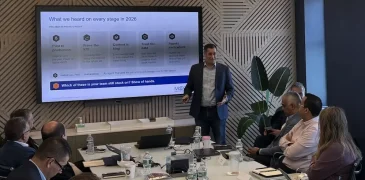
Google Cloud CEO Thomas Kurian delivers the keynote at Google Cloud Next 2026. (Credit: Moor Insights & Strategy)
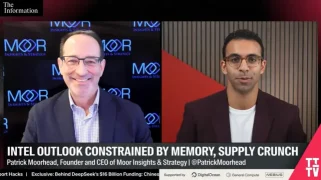
That said, there were plenty of other things going on, including the Adobe Summit (Mel has the scoop on that), Intel’s surprisingly strong earnings (see Anshel Sag’s “Semiconductors” entry), and, as icing on the cake, the big announcement that longtime Apple exec John Ternus would succeed Tim Cook as Apple’s CEO — which I commented on for CNBC. Whew!
This week, Jason and Mel are in San Francisco for the What’s Next With AWS event, with Mel also attending some of the Oracle Applications Summit while in town. Anshel and Mel will be in Bellevue, Washington, for a T-Mobile event, and I’ll be at TT-Deploy in San Francisco. The spring season of client and vendor events is here, and we’re on the road a lot over the coming months. If you’ll be attending any of the same events or see that we’ll be in your city, please reach out.
Last week was a banger for Moor Insights & Strategy analysts quoted in the news. Our insights on major events, executive changes, and tech company earnings (to name just a few) were featured across multiple leading business and technology publications, including the Wall Street Journal, CIO, PC World, and Business Insider. Check out the full list of citations here.
Our MI&S team also published 8 deliverables — 5 Research Notes, 1 Analyst Insight, and 2 Podcasts.
Check out this week’s Analyst Insights roundup for more from the MI&S team, including what’s top of mind for each analyst, our thoughts on vendor announcements, press quotes, and more.
Have a great week!
Patrick Moorhead
MI&S Analyst Insights
Last week was dominated by Google Cloud Next 2026, and my overall feedback is that Google has gone to great lengths to fill gaps I had identified with its agent strategy last year. In particular, great strides were made in agent observability and governance. My takeaway for enterprises is that Google’s agent products — namely Gemini Enterprise and Gemini Enterprise Agent Platform — are now competitive with other leading products in the space.
That said, there are some distinct capabilities worthy of special mention — plus I want to share a thought on some of Google’s recent claims about openness. First, the capabilities:
- While “agent skills” are not a new concept, I really like how Google treats them as an enterprise capability like MCP tools. In a way it feels like Google has mainstreamed the skills notion with its dedicated Agent Skills registry and better ability to share skills across the enterprise.
- Another positive: I observed some very good tooling updates, especially with respect to workflows and agent orchestration. And those capabilities are quite visible in the updated Google Customer Experience Platform, which I wrote about last year. It’s clear that the Customer Experience team is making big strides by announcing a number of new wins — including Macy’s, which was demonstrated to great success at the event.
- Lastly, it’s easy to forget that while so much of Google’s AI marketing focuses on its Gemini models, Google also has many others, such as voice and image models. As we move past LLMs and chat interfaces, Google has some advantages when it comes to multi-model agents.
One last note on Google’s agent play: At last week’s event, executives and other speakers went to considerable lengths in calling Gemini’s agentic products “open.” Again, a tip of the hat to Google for making strides here, but this is another messaging statement that places Google in a better competitive space than others that have done at least as much on the openness front.
Last week I also had a great conversation with the team from Weights & Biases, which is now part of CoreWeave. To be honest, I did not know a lot heading into the meeting — but I walked away impressed. And while CoreWeave completed the W&B acquisition about a year ago, it’s clear that they have something more akin to a GitHub/Microsoft model than a full integration play, which means that W&B is not limited to using the CoreWeave services.
While I learned a lot across the board, two things stuck out the most. The first is that W&B can provide a very granular cross-cloud platform for agent and model observability and training. This is something that hyperscalers and SaaS agent players aren’t able to do, and, in fact, multiple SaaS vendors leveraging hyperscaler infrastructure are using W&B to manage their agentic platforms today. And while that’s interesting in itself, W&B’s vision also connects training and observability ideas, allowing you to get real-time model improvements into a model rather than needing dedicated training builds. It’s kind of a self-correcting, autonomous service that is important in many industries now, but would be mandatory in more futuristic cases like robotics. Between what is going on at W&B and CoreWeave’s recent expansion into storage and other software capabilities, it would seem that CoreWeave is in the midst of pivoting away from its neocloud roots to a more full-service AI infrastructure play.
Last week was dominated by Google Cloud Next 2026, and my overall feedback is that Google has gone to great lengths to fill gaps I had identified with its agent strategy last year. In particular, great strides were made in agent observability and governance. My takeaway for enterprises is that Google’s agent products — namely Gemini Enterprise and Gemini Enterprise Agent Platform — are now competitive with other leading products in the space.
That said, there are some distinct capabilities worthy of special mention — plus I want to share a thought on some of Google’s recent claims about openness. First, the capabilities:
- While “agent skills” are not a new concept, I really like how Google treats them as an enterprise capability like MCP tools. In a way it feels like Google has mainstreamed the skills notion with its dedicated Agent Skills registry and better ability to share skills across the enterprise.
- Another positive: I observed some very good tooling updates, especially with respect to workflows and agent orchestration. And those capabilities are quite visible in the updated Google Customer Experience Platform, which I wrote about last year. It’s clear that the Customer Experience team is making big strides by announcing a number of new wins — including Macy’s, which was demonstrated to great success at the event.
- Lastly, it’s easy to forget that while so much of Google’s AI marketing focuses on its Gemini models, Google also has many others, such as voice and image models. As we move past LLMs and chat interfaces, Google has some advantages when it comes to multi-model agents.
One last note on Google’s agent play: At last week’s event, executives and other speakers went to considerable lengths in calling Gemini’s agentic products “open.” Again, a tip of the hat to Google for making strides here, but this is another messaging statement that places Google in a better competitive space than others that have done at least as much on the openness front.
Last week I also had a great conversation with the team from Weights & Biases, which is now part of CoreWeave. To be honest, I did not know a lot heading into the meeting — but I walked away impressed. And while CoreWeave completed the W&B acquisition about a year ago, it’s clear that they have something more akin to a GitHub/Microsoft model than a full integration play, which means that W&B is not limited to using the CoreWeave services.
While I learned a lot across the board, two things stuck out the most. The first is that W&B can provide a very granular cross-cloud platform for agent and model observability and training. This is something that hyperscalers and SaaS agent players aren’t able to do, and, in fact, multiple SaaS vendors leveraging hyperscaler infrastructure are using W&B to manage their agentic platforms today. And while that’s interesting in itself, W&B’s vision also connects training and observability ideas, allowing you to get real-time model improvements into a model rather than needing dedicated training builds. It’s kind of a self-correcting, autonomous service that is important in many industries now, but would be mandatory in more futuristic cases like robotics. Between what is going on at W&B and CoreWeave’s recent expansion into storage and other software capabilities, it would seem that CoreWeave is in the midst of pivoting away from its neocloud roots to a more full-service AI infrastructure play.
Distance Technologies has partnered with Kia to bring its light-field display technology to Kia vehicles, with the aim of incorporating new AR functions into driving technology. According to the companies, Distance’s tech will initially find its way into the Kia Vision Meta Turismo Concept Car; that should be a good proving ground for Kia’s vision for future vehicles and show how well the companies are working together to deliver that vision. While Distance’s technology is already being integrated into planes and military vehicles, this is the company’s first consumer prototype design. I have always hoped that such technology would find its way into consumer products, and I believe that augmented reality holds great promise for automotive applications, especially with dash displays shrinking or going away entirely in vehicles like Teslas. Kia is a very forward-thinking company, and I could see it commercializing this technology soon.
Governance ran straight through Google Cloud Next. I posted about Agentic Data Cloud, Knowledge Catalog, and Agent Platform in real time, and what jumped out for me is how Google connected governance and security as one story. Google has built the two to work together, and it’s the first hyperscaler I’ve seen do that. The bigger angle is Knowledge Catalog itself. The whole design is about reaching across clouds. Google wants Knowledge Catalog to govern your data wherever it sits. Every hyperscaler is racing to be the center of governance gravity for the agentic era, and right now Google sounds the most complete.
Lots of partner info came out of Google Cloud Next, to the point that it was hard to pick which ones to focus on. I’m putting a little focus on Atlan, an active metadata vendor, and Anomalo, a data quality vendor. Both showed up with stronger governance stories. Atlan deepened its Google Cloud integration and pushed a broader multi-cloud “AI Context Ecosystem” story. It almost feels like Atlan is thinking about AI context as its own category. Anomalo plugged quality directly into Knowledge Catalog and teamed up with Atlan on an agentic-context piece. Two vendors who normally compete for the same buyer teaming up is the part worth flagging here. Agentic context is bigger than any one vendor can carry, and that’s why we’re seeing partnerships form. The independent governance vendors who don’t land a solid partner in the next 90 days are the ones falling behind — if there are any left, that is.
In a heavy news week, Immuta also dropped a piece on access governance for AI agents that probably got lost in the shuffle. Most of what gets called AI governance right now is output control. Think evaluation, hallucination guarding, prompt safety — all the stuff that happens after the model runs. Immuta is pointing at the input side, which is where most breaches actually start. Old access governance assumed humans clicking buttons. Agents read sensitive columns at machine speed, and they don’t ask for permission the way people do. What happens when a long-running agent makes a thousand silent reads against data nobody told it to touch? Old access models can’t see that. I’m watching to see which catalog vendors are looking at it from both directions.
At Google Cloud Next, the company unveiled its eighth-generation TPU portfolio. I say “portfolio” because Google announced the TPU 8t (training) and TPU 8i (inference), along with networking (Virgo) and system-level integration (AI Hypercomputer) to deliver highly specialized silicon across the AI lifecycle. The architectural reasoning is sound. Training is a throughput problem; inference is a latency and memory bandwidth problem. Google’s view is that engineering for both in the same chip means compromising on both. AWS took this path years ago with Trainium and Inferentia. Google has now done the same.
Interestingly, as Google pivots to discrete silicon for training and inference, AWS has pivoted back the other way, with CEO Matt Garman noting that Trainium could handle much of the training and inference-heavy lifting. AWS also recently announced a partnership with Cerebras to deliver disaggregated inference, where latency issues around token generation and delivery are better addressed. Meanwhile, Google seems not to have addressed this “disaggregated” opportunity (which was also a major theme at GTC earlier this year).
Back to TPU. The scale numbers are impressive, though largely irrelevant to enterprise IT. A 9,600-chip training pod connected by optical circuit switches is an architecture that will make a frontier model provider excited — but is fully disconnected from what an enterprise IT organization would care about.
What matters more is price-performance when AI is activated (i.e., inference). To that end, Google is making bold claims about TPU 8i’s improvements over Ironwood (TPU 7). Assuming its claim of an 80% improvement in performance-per-dollar holds up, that could be significant. But again, Google’s claim feels a bit hollow. All claims compare TPU 8 to TPU 7, while the obvious relevant comparisons to Trainium, NVIDIA, and maybe even Azure’s Maia are absent. Further, I don’t know an enterprise CIO who puts any stock in a vendor’s own claims around performance or price-performance.
On the model-support front, Google states support beyond Gemini, with Llama, Qwen, and others running via vLLM on TPU. But multi-host configurations aren’t supported yet, and PyTorch is still in preview.
Maybe most confusing to me here is trying to understand who Google’s target customer is. Is TPU 8 designed and built solely to support the company’s recent partnership with Anthropic? Or is Google looking to establish a more relevant foothold in the enterprise AI space?
I don’t see anything that suggests the company is serious about penetrating the enterprise market (which has long been an elusive segment). This spans product, product delivery, and target GTM messaging. As Google builds what looks like impressive silicon, networking (Virgo), and systems (AI Hypercomputer), I don’t see anything that would resonate with an enterprise IT organization looking to deploy AI that, even if it originates in the cloud, will have a strong on-prem presence. Even the company’s distributed cloud (on-prem cloud) only supports NVIDIA.
My take: Google may have developed some great technology. But it has a long way to go in making it relevant for the enterprise.
Google led Google Cloud Next with its biggest first-party storage push in years. As AI models scale, the bottleneck shifts from compute to storage. Storage feeds the accelerators, and if storage can’t keep up, every idle GPU minute is money lit on fire. That becomes a TCO problem pretty quickly. Google’s answer is to push performance directly into the storage layer. The announcements cut across the stack, with Cloud Storage Rapid for performance object storage, Managed Lustre at 10x throughput with a cheaper Dynamic tier, Smart Storage automating metadata for agents over MCP, and Storage Intelligence dashboards on top. Every move was a TCO play built around keeping accelerators full.
There were lots of storage partner announcements at GCN, too. I’ll spotlight two of them. First, NetApp launched Unified File+Block on Google Cloud, the second major NetApp–GCP announcement inside a week. That makes NetApp the only storage vendor with co-engineered, first-party deals across all three of the hyperscale cloud service providers, covering both commercial and sovereign clouds. And then DDN landed on Google Cloud Managed Lustre the same day, putting DDN on all three hyperscalers in lockstep. Both moves tell me that AI workloads need specific kinds of storage, and the hyperscalers are leaning on best-in-class vendors to provide them. The vendors who get there first are sure to have a crazy advantage for owning the storage foundation of the agentic stack.
ServiceNow recently finalized its $7.75 billion acquisition of Armis, a move that integrates real-time asset visibility and cyber exposure management directly into its primary AI platform. This transaction follows the March 2026 acquisition of Veza, signaling a shift in ServiceNow’s strategy toward building a comprehensive security control tower for the enterprise. By integrating Armis’s ability to monitor nearly 7 billion devices across traditional IT, OT, and medical devices into its existing workflow engine, the company aims to bridge the structural gap between threat detection and remediation.
This acquisition is a calculated response to the rising complexity of agentic AI and the expanding attack surfaces of modern infrastructure. Traditionally, ServiceNow functioned as the system of record for IT services, while security was handled by fragmented point solutions that identified risks but lacked the operational connective tissue to fix them. By owning the asset intelligence layer (Armis) and the identity intelligence layer (Veza), ServiceNow is positioning itself to own the entire remediation lifecycle. This puts significant pressure on standalone cybersecurity vendors like Palo Alto Networks or CrowdStrike, as ServiceNow can now argue that a unified workflow platform is more efficient than a collection of disparate tools. For the industry, this suggests a consolidation trend in which value shifts from mere detection to autonomous, closed-loop governance.
I’ll be at ServiceNow’s Knowledge 2026 conference in May and look forward to seeing whether this strategy is already moving from narrative to measurable impact. In the near term, success should look like concrete customer examples where Armis and Veza data is driving automated playbooks that cut mean time to remediation, reduce manual handoffs between SecOps and IT, and shrink blind spots in OT and medical environments. I’ll be looking for early design patterns and reference customers that show AI‑driven workflows autonomously resolving at least a subset of risk factors in production.
Adobe held its annual Adobe Summit in Las Vegas last week and put its CX Enterprise offering at the center of its customer experience story. The company positions CX Enterprise as an agentic control layer above Adobe Experience Platform and existing applications. CX Enterprise and the new CX Enterprise Coworker are meant to orchestrate journeys, content, and decisions across Adobe’s CX stack.
Three themes stood out. First, Adobe is framing CX Enterprise as a governed system for agentic marketing, with Brand Intelligence as the brand brain, Engagement Intelligence as the decisioning layer, and Coworker as the orchestrator that runs against business goals rather than just campaigns. Second, Adobe is treating AI discovery as a CX surface in its own right, with a brand visibility solution and LLM Optimizer updates aimed at measuring and improving how brands appear in AI-powered browsers, assistants, and answer engines.
The third theme brought together ecosystem and accountability. Adobe emphasized that CX Enterprise runs across AWS, Azure, Google Cloud, IBM, and NVIDIA, and connects into Copilot, Gemini, ChatGPT Enterprise, and Claude. In this context, I see a clear need for blueprints that clarify ownership of the coworker layer, policy enforcement across partner environments, and the metrics that tie this architecture back to revenue and retention.
Across these themes, Adobe also spent time reinforcing the role of human creativity. The company consistently framed AI and agentic workflows across the content supply chain as accelerators for content velocity and risk management, not replacements for the unique creative judgment and brand sensibility that human teams bring to campaign development.
This all lands squarely in CMO and CTO territory, with finance looking for evidence that the story holds up. That CMO/CTO partnership, and how it is framed for CFOs and shareholders, is where I expect most of the near-term decision-making to concentrate. I will soon publish a full research note that breaks down CX Enterprise, Coworker, the content supply chain, and Adobe’s brand visibility offering in more detail.
At Google Cloud Next, Google announced Agentic Data Cloud as the umbrella for everything it’s doing on the data and analytics side. This pulls together BigQuery updates, Spanner Omni, Looker updates, Gemini across all of it, Knowledge Catalog for context, and the Data Agent Kit for spinning up agents on top. I’m working on a much deeper take in a research note shortly, so I won’t dig into every piece here. But the headline is that Google has framed a tightly integrated data plane that agents can reason across and act on, while most competitors still ship the pieces separately. Really good work in delivering far greater trust across the data foundation.
The announcement that didn’t fool anyone was Lightning Engine for Apache Spark. The company says that its new serverless real-time engine clocks up to 4.5x faster than open-source alternatives and delivers 2x better price-performance compared to “the leading alternative.” I think everyone who cares about this knows that Databricks IS Spark. The founders built it, and the company’s identity, customer base, and a ton of its innovation is built on top of it. Google announcing that it runs Spark faster than Databricks is a direct shot at the heart of the Databricks narrative. The framing specifically focused on performance and TCO. Everyone read it as a Databricks rip. Is this the start of a more direct rivalry? At the Databricks Data + AI Summit in June, it should be interesting to see if Databricks takes the bait or just keeps plugging away.
The day before Google Cloud Next kicked off, Snowflake announced Snowflake Intelligence and Cortex Code with Cortex Agents as the platform underneath — the full agentic stack rollout. The timing felt like a deliberate attempt to grab some of the oxygen before the GCN keynote on Wednesday morning. The issue was that Google was loud enough that the Snowflake news got crowded out within a day. But the announcement itself still matters. Snowflake Intelligence is the conversational data interface, Cortex Code is the agent development framework, and having Cortex Agents underneath brings MCP connectors, code execution, budgets, versioning, and evaluations to govern it all. That’s a meaningful step toward the open-ecosystem positioning Snowflake has been chasing since the Polaris and Iceberg work. Snowflake’s bet is that being early on MCP and openness will pay compounding dividends. We’ll see whether the market rewards that ahead of execution.
Xbox’s new CEO, Asha Sharma, is already shaking things up as the head of all of Microsoft’s gaming efforts. This includes dropping the price of Xbox Game Pass Ultimate from $29.99 per month to $22.99 and removing Call of Duty as a launch title. In addition to that, the company seems to be pivoting back to Xbox as the lead brand and redesigning the logo with a bit of nostalgia. The company also teased a partnership with Discord, which seems like it will include a free tier of Xbox Game Pass paired with Discord’s Nitro paid service. There also seems to be an appetite for more exclusives once again, which I have mixed feelings about. Look for more updates from me on this as more details emerge.
Hannover Messe 2026: Industrial AI in Deployment Mode
The annual Hannover Messe conference in Germany is a key convergence point for industrial technologies: energy systems, industrial automation, robotics, and the software that ties them together. This year’s theme, “Think Tech Forward,” signaled a shift in focus from technology development to operational acceleration. In 2025, we established that AI is coming to the factory floor — and fast. The questions for 2026 are what the AI stack will look like and which companies will control it.
Industrial AI Stack Stratification
Hannover Messe 2026 revealed a significant trend toward stratification of industrial AI capabilities into distinct layers. Hyperscalers are connecting agentic AI downward to interact with operational ground truth. Industrial incumbents, including Siemens, Schneider Electric, ABB, and SAP, are connecting to cloud-based enterprise ecosystems. Neither class is trying to occupy the other’s layer; both are building the connections that replace end-to-end software mashups with layers that form a scalable continuum from the factory floor to the cloud.
Microsoft made the deepest footprint. Its “Industrial Intelligence Unlocked” theme positioned Azure not as a cloud destination but as a coordination layer spanning the manufacturing value chain — Work IQ for workforce collaboration, Fabric IQ for real-time asset visibility, and Foundry IQ for institutional knowledge and agentic workflows. Siemens, ABB, KUKA, Schneider Electric, Krones, and a joint agentic factory demonstration from Accenture and Avanade anchored the integration concepts in reality.
AWS came with a different approach — less enterprise integration, more factory floor. Its anchor partnership with Rockwell Automation gave it credibility in physical operations that pure cloud vendors typically lack. Rockwell brought autonomous mobile robots, digital twin environments, and factory software directly into the AWS story. Neura Robotics separately announced a collaboration with AWS to bring physical AI to industrial scale.
NVIDIA deserves its own category. Siemens, ABB, Dassault Systèmes, SAP, Microsoft, and Krones were all building on NVIDIA’s physical AI stack — accelerated compute, Omniverse digital twin libraries, and Jetson edge inference modules. At a Siemens electronics factory in Erlangen, a wheeled humanoid robot running Jetson Thor completed an autonomous logistics proof-of-concept. The silicon competition is real and intensifying. Google announced TPU 8t and 8i at Cloud Next last week (see Matt Kimball’s write-up under “Datacenter — Silicon” elsewhere on this page) , while AWS continues to expand Trainium and Inferentia — a contest that will play out for years. But in industrial AI, NVIDIA’s leverage lies in the physical AI software frameworks that industrial vendors have already standardized on. Replacing a training chip is an economic decision. Replacing Omniverse, Isaac, and Jetson in a digital twin pipeline is an architectural rebuild.
The Orchestration Prize
Beneath the alliance activity, a more fundamental dynamic is visible: a contest for the orchestration layer that coordinates across automation silos, manages AI agents at scale, and hosts the physical operational context.
The industrial incumbents each arrived at Hannover with impressive AI narratives. Schneider Electric demonstrated a software-defined automation framework that decouples control logic from hardware. SAP showed agentic applications spanning asset health, supply chain orchestration, and field service dispatch. These are serious efforts, but they are inherently vertical, optimized for customers already inside each vendor’s ecosystem. The hyperscalers are making the horizontal argument: an orchestration layer that sits above any automation vendor’s hardware and below any enterprise application. Microsoft is the most vocal horizontal contender, but nobody has cleanly claimed the prize yet.
The Industrial Substrate — Coming Soon to a Factory Near You
The most strategically significant category at Hannover Messe 2026 was the rapidly emerging concept of the industrial data substrate — the layer between OT systems and enterprise AI that generates ROI by connecting AI to the real world.
Litmus announced two products at the show: Edge Bridge for Microsoft Azure IoT Operations, which automates discovery and onboarding of PLCs, sensors, and controllers; and Data Catalog, which addresses what the company calls a data trust problem rather than a data volume problem. HighByte demonstrated a parallel data fabric at the AWS booth. The pattern is consistent: a new industrial data platform category is emerging between the machine and the cloud, solving the context and governance problems that prevent AI from scaling. I predicted this development in October 2025 in this Forbes article, and there was plenty of evidence supporting that view at Hannover Messe 2026.
My Take
Two directions of work are visible at Hannover Messe 2026. “Context-up” makes machine data legible, governed, and AI-ready with less custom software. “Action-down” acts on agentic AI decisions by orchestrating the delivery of commands back down to physical systems. But closing the sense-think-act loop generates governance anxiety. Who authorized that setpoint change? What’s the audit trail? Is the command safe? Does it need approval? Can it be overridden?
The factory of the future was on display in Hannover this week, but three questions remain unanswered.
- Is the industrial data substrate mature enough to feed enterprise AI with the context it needs to act intelligently?
- Is the operational AI layer mature enough to govern enterprise AI commands that affect physical safety?
- Can manufacturers afford to build and sustain this new data substrate and operational layers at the price the market is currently asking?
All three answers are becoming critical as we look toward 2027. This year’s theme was “Think Tech Forward.” Maybe next year’s theme should be “Think Operations Forward” — a foundational, operations-centric view of real-world AI.
Jeff Bezos’s Blue Origin carried AST SpaceMobile’s Bluebird 7 satellite to space successfully, but its second stage failed to reach an altitude that would allow it to successfully orbit. As a result, the satellite is being deorbited and the entire satellite is being scrubbed, unfortunately becoming an insurance loss. This is an unfortunate setback for both companies, and it’s a good reminder of the reality in the satellite business that this kind of thing can happen. I believe that both companies will continue to move forward after they uncover the cause(s) for the satellite not reaching a proper orbit.
Workspace updates at Google Cloud Next do not always get the same attention as infrastructure or model news, but they are often what change how people work every day. Google’s introduction of Workspace Intelligence at this year’s event signals a shift in how Workspace is organized and how Gemini AI works for users. Google is creating a shared understanding of content across Gmail, Drive, and Chat so that Gemini can use the same context no matter which Workspace app someone is in; this should make Workspace feel more like a single system rather than a collection of disparate apps.
A key part of this is the move toward more agent-like behavior in Workspace. With Workspace Studio, teams can turn repeatable processes into reusable “skills” that run across data sources. For example, a sales operations lead could set up a skill that scans new deal desks and contract drafts in Drive, compares them with prior approvals in Gmail and Chat, and flags terms that may be out-of-policy. That type of pattern can reduce manual checks and context switching, and keep more of the review work within Workspace.
Google is also pushing a canvas-style approach to productivity (a trend I’ve been tracking across UC and productivity platforms and core operations), where Sheets and Slides are used as frontends for generated output. Features such as daily briefings and meeting summaries that integrate with Zoom and Teams can reduce the time people spend piecing together what happened and what needs to be done next, potentially improving the quality and follow-through of post‑meeting work. At the same time, client-side encryption and regional data processing should give enterprises clearer control over how and where their data is handled, which could make it easier to apply AI to higher‑value and more sensitive workflows.
Microsoft has revamped its insider program to enable more feedback from early testers, along with a better tiered model. This is a clear transition from Microsoft, which is looking to get more feedback from users earlier in Windows’ development cycles so it can fix problems and improve functionality earlier. This comes right on the heels of Microsoft’s announcement that it would focus more on solving common problems within Windows to improve the experience for everyday users. I believe that Microsoft is feeling pressure from both Linux and MacOS to improve its OS; without concrete improvements, Microsoft runs the risk of losing market share to both.
Intel earnings beat all expectations, buoyed in part by Tesla’s announcement that Intel would be the foundry partner for Tesla’s Terafab using Intel’s upcoming 14A process node. Tesla could be one of Intel’s biggest customers for the future, with Terafab slated to supply both Tesla and SpaceX with chips for all of their AI needs. This also means that domestically designed and produced chips will go into American-made products, accomplishing exactly what the CHIPS Act was created to do. The rosy earnings report shot Intel’s stock above $82, a far cry from its 52-week low of $18.96. The rise put Intel’s stock price and market cap (now more than $400 billion) higher than they had ever been in the company’s history.
Google took the wraps off its eighth-generation TPU, with a new dual-chip architecture enabling different TPUs for training and inference. While many details about its performance and efficiency are now public, like 4x better networking bandwidth per chip, it is still unclear whether Google also split its manufacturing of the chip between MediaTek for inference and Broadcom for training. Both chip companies’ products are still fabbed at TSMC.
Research Notes
- First-Take Analysis: Nuvacore Emerges from Stealth Mode (Matt Kimball)
- The HP Z2 Mini G1a: A Tiny Powerhouse for the AI Workstation Era (Anshel Sag)
- HP Imagine 2026: HP Evolves in the Era of AI (Anshel Sag)
- Broadcast Analysis: Patrick Moorhead Discusses Apple’s New CEO and Future Strategic Direction on CNBC, April 20, 2026 (Patrick Moorhead)
- Lenovo Closes Infinidat Acquisition — What Does It Mean for Enterprise Storage? (Matt Kimball)
Press Citations
Agentic AI Platforms / Jason Andersen / AI Tech Trend
Agentic AI Platforms: How Tech Giants Are Racing for Enterprise Adoption
Agentic AI Platforms / Jason Andersen / InfoWorld
The agentic AI frenzy increases as more vendors stake their claims
Apple / New CEO John Ternus / Patrick Moorhead / Business Insider
Apple’s CEO pick is a bet on hardware in the AI age
Apple / New CEO John Ternus / Patrick Moorhead / CNBC
Apple goes for the ‘continuity candidate’ to replace Cook. What the CEO change means for investors
Apple / New CEO John Ternus / Anshel Sag / Fierce Network
Apple gets a new CEO in 2026 as John Ternus replaces Tim Cook
Apple / New CEO John Ternus / Patrick Moorhead / WSJ
What a New Apple CEO Will Mean for You and Your Devices
Commvault / Commvault Cloud Platform available on Google / Mike Leone / Security Brief
Commvault brings cloud resilience tools to Google Cloud
Google / Agentic Data Cloud / Mike Leone / InfoWorld
Google pitches Agentic Data Cloud to help enterprises turn data into context for AI agents
Google / Gemini, Google Cloud 2026 / Mike Leone / Computer World
Google pushes Gemini toward ‘agentic enterprise’ with new platform and workflow tools
Google / Google Cloud 2026, CIO, AI / Mike Leone / CIO
What Google’s “unified stack” pitch at Cloud Next ‘26 really means for CIOs
IBM / AI Bias / Mike Leone / CIO
IBM shareholder proposal demands IBM defend AI bias protocols
Meta / Compute Grab / Matt Kimball / Network World
Meta’s compute grab continues with agreement to deploy tens of millions of AWS Graviton cores | Network World
NVIDIA / AI Agents / Matt Kimball / DataCenter Knowledge
Nvidia: AI Agents Break the Data Center Throughput Model
PCs, MacBooks, Intel Chips / Anshel Sag / Gizmodo
PC Makers Are Gonna Struggle Making a MacBook Neo Killer
RAM prices / Patrick Moorhead / PC World
Investigation: Are RAM prices dropping, or is it all illusion?
Snowflake / Ai Agents / Mike Leone / InfoWorld
Snowflake offers help to users and builders of AI agents
Press Release Quotes
Commvault / Commvault Cloud Platform available on Google / Mike Leone / Commvault
Commvault Extends the Full Breadth of its Next-Generation Cyber Resilience Platform to Google Cloud
Sony / Playstation haptics and 3D audio / Anshel Sag / Wired
Saros Shows Off the PS5’s DualSense Tricks
Broadcasts
Apple / Patrick Moorhead / CNBC
Incoming CEO Ternus is Apple’s ‘continuity candidate’, says Moor Insight’s Patrick Moorhead
Other Video Appearances
Apple, Moto, OPPO, Huawei / New Apple CEO and Mobile Tech / Anshel Sag / WorldPodcasts
Apple CEO Transition, Moto G Stylus 2026 and OPPO Find X9 Ultra Hands-On, OPPO Find X9S and X9S Pro, Huawei Pura X Max and Pura 90 Pro Max, and More with Anshel Sag of Moor Insights & Strategy — Mobile Tech Podcast 476
New Gear or Software We Are Using and Testing (New)
- HP Z2 Mini G1a (Anshel Sag)
- Samsung Galaxy Book6 Pro (Anshel Sag)
- Meta Ray Ban Display (Anshel Sag)
- ASUS Zenbook A16 with Qualcomm Snapdragon X2 Elite Extreme (Anshel Sag)
- HP EliteBoard G1a (Anshel Sag)
- Anker Nano Power Strip (10-in-1, 70W, Clamp) (Anshel Sag)
- Claude Cowork (Jason Andersen)
- Microsoft Copilot Studio (Jason Andersen)
- HyperX Cloud Alpha III Wireless (Anshel Sag)
- HyperX FlipCast Microphone (Anshel Sag)
- Anker Mag Go Prime Wireless Charging Station (Anshel Sag)
- Anker Nano Charger (Anshel Sag)
- Lenovo Legion Go 2 (Anshel Sag)
- Samsung Galaxy XR (Anshel Sag)
- OnePlus 15 (Anshel Sag)
- Oppo Find X9 Pro (Anshel Sag)
- Apple M5 MacBook Pro (Anshel Sag)
- Google Pixel 10 Pro Fold (Anshel Sag)
- Google Pixel 10 Pro XL (Anshel Sag)
- Miku Pro Baby Monitor (Anshel Sag)
- Naya Create Modular Keyboard (Anshel Sag)
- Poco F7 Ultra Smartphone (Anshel Sag)
- 2.0 Antec Flux Pro Case (Anshel Sag)
- 2.1 GeForce RTX 5070 and 5070 Ti (Anshel Sag)
- Steelseries Arctis Nova Pro Wireless Headset (Anshel Sag)
Events MI&S Plans on Attending, in Person or Virtually (New)
Unless otherwise noted, our analysts will be attending the following events in person.
- What’s Next With AWS, April 28, San Francisco (Melody Brue, Jason Andersen)
- Oracle Application Summit, April 28, San Francisco (Melody Brue)
- T-Mobile NDA event, April 28, Bellevue, Washington (Anshel Sag, Melody Brue)
- What’s Next With AWS, April 28, San Francisco (Melody Brue, Jason Andersen)
- Oracle Application Summit, April 28, San Francisco (Melody Brue)
- T-Mobile NDA event, April 28, Bellevue, Washington (Anshel Sag, Melody Brue)
- TT-Deploy, May 1, San Francisco (Patrick Moorhead)
- Oracle Analytics Summit, May 4-6, Redwood Shores, CA (Mike Leone)
- IBM Think, May 4-7, Boston (Patrick Moorhead, Jason Anderson)
- ServiceNow Knowledge 2026, May 4-7, Las Vegas (Melody Brue)
- SAP Sapphire, May 11-13, Orlando (Jason Andersen)
- Zendesk Relate, May 18-20, Denver (Melody Brue)
- Dell Technologies World, May 18-21, Las Vegas (Matt Kimball, Patrick Moorhead, Mike Leone)
- Cisco Live!, May 31-June 4, San Diego (Matt Kimball, Melody Brue)
- Snowflake, June 1-4, San Francisco (Patrick Moorhead)
- NetApp Analyst Summit, June 6-8, San Jose (Matt Kimball, Mike Leone)
- Broadcom Mainframe Analyst Summit, Boston, June 8-10 (Matt Kimball)
- AWS Analyst Summit, June 15-17, New York (Jason Andersen)
- Databricks Data + AI Summit, June 15-18, San Francisco (Mike Leone)
- HPE Discover, June 15-18, Las Vegas (Matt Kimball, Patrick Moorhead)
- Pure Accelerate, June 16-18, Las Vegas (Matt Kimball)
- Connectivity Standards Alliance Unify 2026, June 16-18, Austin (Bill Curtis)
July events coming soon.
August events coming soon.
September events coming soon.
- WebexOne, October 6-8, Austin (Melody Brue)
- Oracle AI World + SuiteWorld 2026, October 26-29, Las Vegas (Matt Kimball)
- Dell Analyst Summit, November 2-4, Austin (Matt Kimball)
December events coming soon.
Subscribe
Want to talk to the team? Get in touch here!